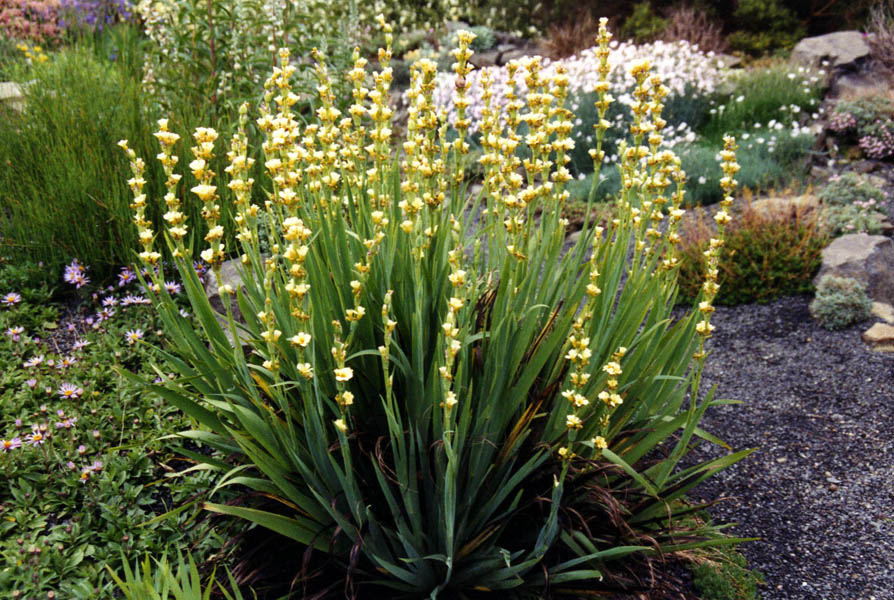
Perennial from the Iridaceae family, native to Chile and Argentina, where it grows in open meadows, grassy slopes, and rocky areas with well-drained soil, from lowlands to moderate altitudes.
It forms large upright clumps of ribbon-like, flattened, glaucous to gray-green leaves, reaching 40 to 60 cm, with a distinctly architectural habit reminiscent of a small iris. The flowering stems, robust and upright, can exceed 60 cm and bear numerous flowers arranged in elongated, dense spikes. The six-tepaled flowers are cream-yellow to pale yellow striped with brown-purple veins, giving them the characteristic radiating appearance visible in the photo. The entire flowering stem forms a dense and generous column, very different from the airy habit of other sisyrinchiums.
In its natural habitat, its flowering extends from November to January, due to the southern hemisphere. In cultivation under our climates, it blooms from May to July.
It is cultivated in full sun, in well-drained, moderately fertile soil. It tolerates dry to fresh soils but fears excessive winter moisture. Hardy to about -10°C according to sources, light protection may be useful in cold regions.