Perennial of the Caryophyllaceae family, native to the Eastern Carpathians and the mountains of Eastern Central Europe, where it grows on rocks, rocky slopes, and forest edges at altitude, generally between 800 and 1,800 meters.
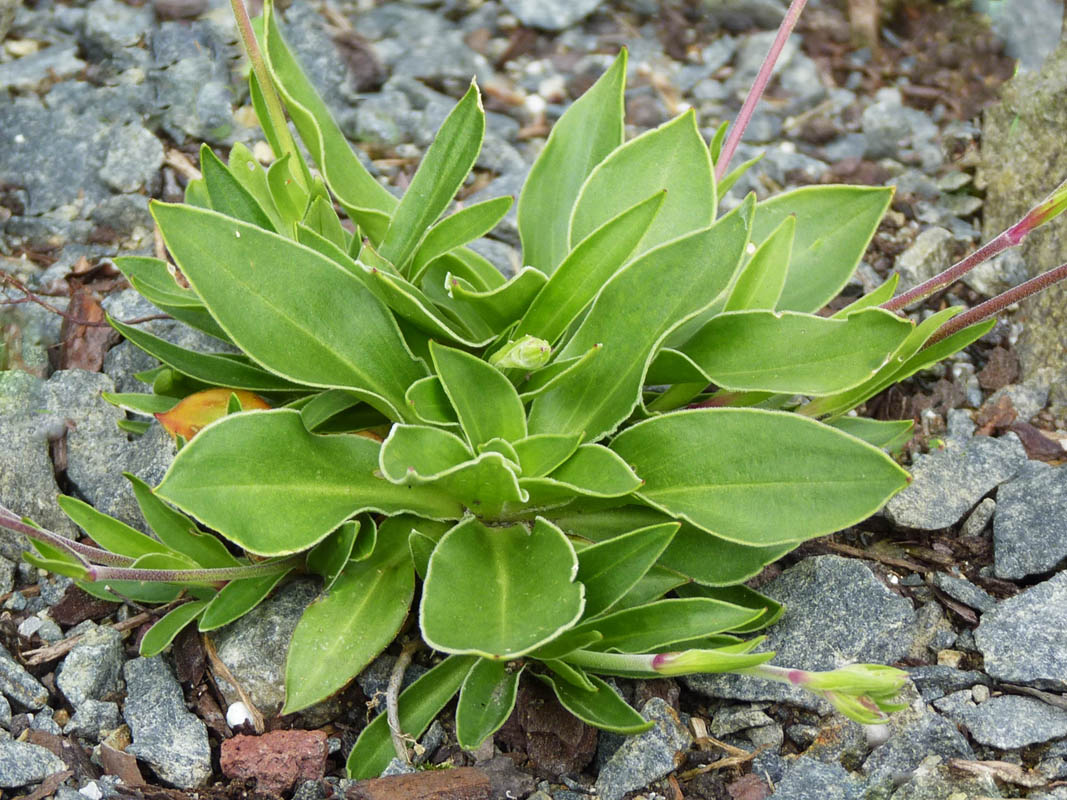
It forms a remarkably ample and spread-out basal rosette, composed of oblong-spatulate leaves, a bright and shiny green, with slightly ciliate margins. This broad and orderly rosette foliage is one of the most striking features of the plant at rest, giving it a very clear silhouette on a stony substrate. The flowering stems rise to 20–35 cm, tinged with red-violet, slender and arched at the top.
The flowers are white, with five deeply bifid petals, carried in a loose and drooping cyme; the calyxes are oval-cylindrical, streaked with greenish to slightly reddish veins. The entire inflorescence has an airy and delicate character, contrasting with the robustness of the rosette. In its natural habitat, its flowering extends from June to August.
In cultivation, it appreciates a well-drained, moderately fertile soil, in a sunny to light partial shade exposure. It withstands cold winters without special protection. Relatively uncommon in horticulture, it deserves more attention for its qualities of both foliage and flowering.