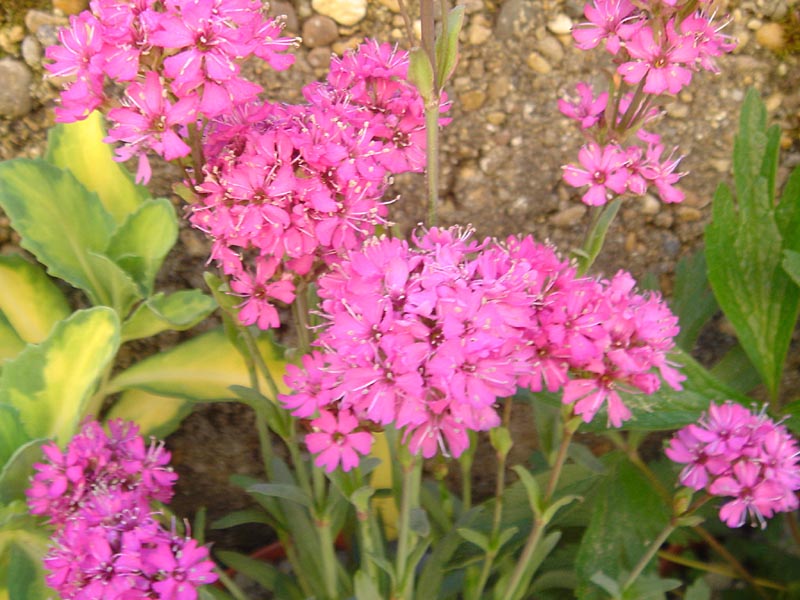
syn. Silene viscaria
syn. Silene viscaria
Perennial of the Caryophyllaceae family, widely spread in Europe, from the Iberian Peninsula to Scandinavia and Western Asia. It frequents dry meadows, rocky lawns, heaths, and sunny slopes on poor, acidic to neutral, well-drained soils.
It forms upright clumps from 20 to 50 cm, with linear-lanceolate basal leaves, medium green, arranged in a rosette. The flowering stems are remarkable for their internodes coated with a glandular and sticky, dark brownish zone that effectively traps small crawling insects — a trait that is the origin of the English vernacular name catchfly. This characteristic is visible to the naked eye and constitutes an immediate identification sign.
The flowers are bright pink to deep magenta, gathered in whorls forming interrupted clusters, each flower with five slightly notched petals. In its natural habitat, its flowering extends from May to July. In cultivation, it blooms from May to June.
It accepts varied conditions provided the soil is well-drained and the exposure is sunny; it tolerates summer drought once established. Horticultural selections with double flowers exist, including the very widespread 'Splendens Plena'. A robust, undemanding plant that reseeds moderately.