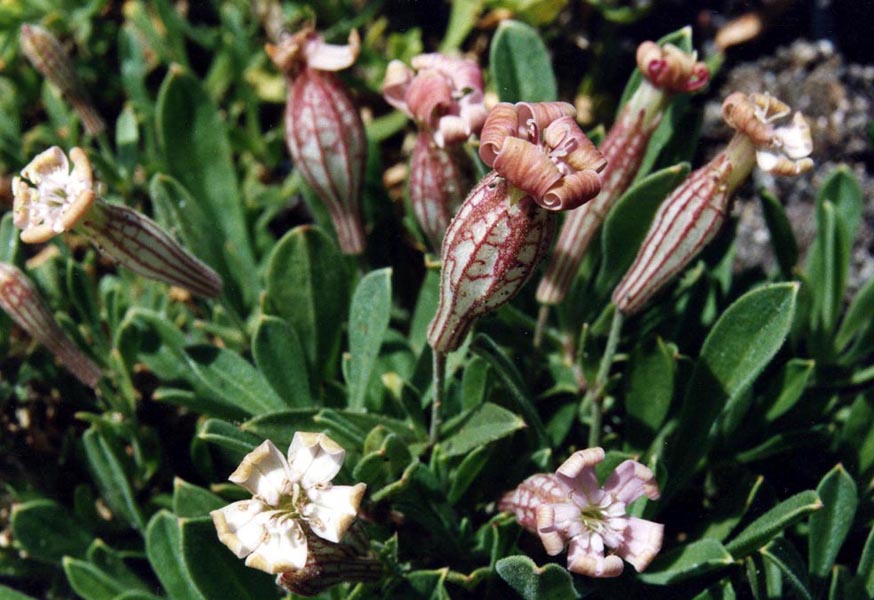
Perennial of the Caryophyllaceae family, native to the western and central Alps, mainly in the Valais, Dauphiné, and Maritime Alps massifs, with some stations in the northern Apennines. It occupies screes, sunny rocky areas, rock crevices, and dry rocky slopes, generally between 1,500 and 2,500 meters altitude, on calcareous or siliceous substrates.
It forms a low and dense tuft of 5 to 15 cm, with oblong leaves, a grayish-green, slightly sticky to the touch — a glandular characteristic found on the stems. It is precisely this stickiness that gives the plant a reputation as a trap for small insects, although it is a passive phenomenon without digestion.
The calyces are the most spectacular element of the plant, strongly swollen and streaked with wine-red on a whitish background, very ornamental even without open flowers. The petals, pale pink to whitish, are spirally rolled in the bud state, unfolding into a corolla with narrow, reflexed lobes. In its natural habitat, its flowering extends from July to August.
In cultivation, it requires perfect drainage, poor and stony soil, full sun exposure. It is grown in rock gardens or troughs and does not tolerate prolonged humidity in winter.