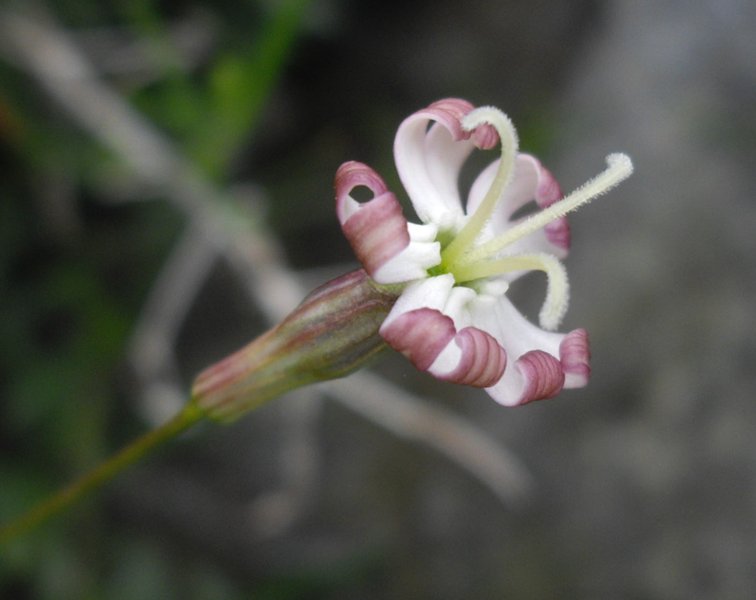
Perennial of the Caryophyllaceae family, present in the mountains of central and southern Europe, from the Alps to the Balkans and the Apennines. It occupies calcareous rocks, fissures, and sunny screes, generally between 500 and 2,000 meters in altitude.
It forms low and loose tufts of 10 to 20 cm, from a persistent woody base. The stems are slender, erect or ascending, bearing linear-lanceolate leaves, glabrous, often ciliated at the base. The foliage, fine and dense at the base, resembles in its habit certain saxifrages, which earned it its epithet.
The flowers, solitary or in very loose cymes, feature an elongated, tubular calyx, streaked with purple to red-violet veins that are very ornamental, contrasting with the white to white-pink, bifid petals, which open in a star shape. This colorful and finely veined calyx is one of the most immediately recognizable traits of the species.
In its natural habitat, its flowering extends from June to August depending on the altitude. In cultivation, it requires a calcareous, very well-drained substrate, in a warm and sunny exposure; it tolerates summer drought well once established and is perfectly suited to wall crevices or calcareous rock gardens.