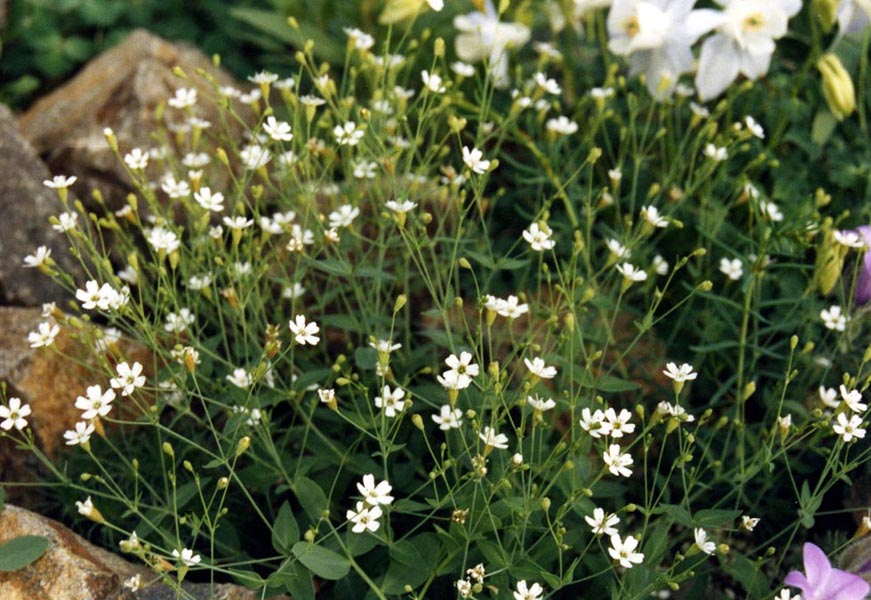
syn. Silene rupestris
syn. Silene rupestris
Perennial of the Caryophyllaceae family. The species is widely distributed in the mountains of central and southern Europe, from the Pyrenees to the Carpathians and the Balkans, where it colonizes siliceous rocks, scree, and rocky alpine meadows, generally between 1,000 and 2,500 meters.
It forms light and branched tufts of 10 to 25 cm, with slender, erect, glabrous, and glaucous stems. The leaves, oval-lanceolate, are arranged in opposite pairs along the stems. The entire plant presents a discreet bluish-green hue that highlights the whiteness of the flowers.
The white flowers, sometimes very slightly pinkish, are borne in loose and airy dichotomous cymes that give the plant the appearance of a cloud floating above the foliage. The petals are bifid, the calyx short and glabrous, with well-visible greenish veins.
In its natural habitat, its flowering extends from July to August. In cultivation, it is accommodating on well-drained substrate, poor to moderately rich, preferably acidic to neutral, in full sun. It readily reseeds itself and spontaneously establishes in rock crevices.