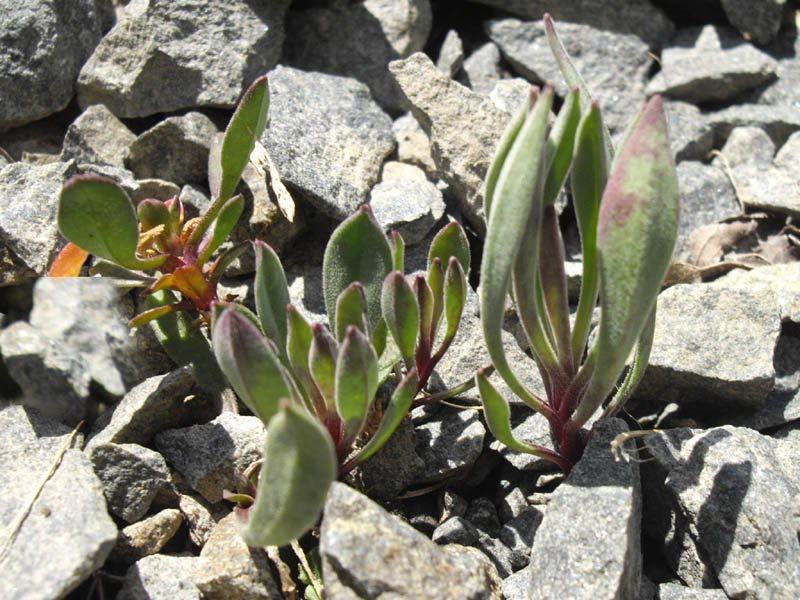
Perennial of the Caryophyllaceae family, described by Maguire in 1941, whose native range extends from Nevada to Utah. It primarily grows in the subalpine zone, in rocky areas and limestone screes in full exposure, on coarse and perfectly drained mineral substrates.
It forms small low tufts with prostrate to slightly ascending stems, not exceeding 15 cm. The oblanceolate leaves, 2.5 to 5 cm, are densely covered with a sticky glandular pubescence; their color ranges from dark green to an intense purple-violet that often invades almost the entire blade, stems, and even calyxes.
The calyx is one of the most striking features of the species — strongly inflated, streaked with very marked purple veins and covered with sticky glands, it is itself as colorful as the flower. The petals are bright pink-purple to magenta, deeply divided, traversed by darker veins, reaching 2.5 cm or more in diameter when in bloom.
In its natural habitat, its flowering extends in summer. In cultivation, it requires perfect drainage, a poor mineral substrate, and full sun exposure; stagnant winter humidity is unfavorable to it.