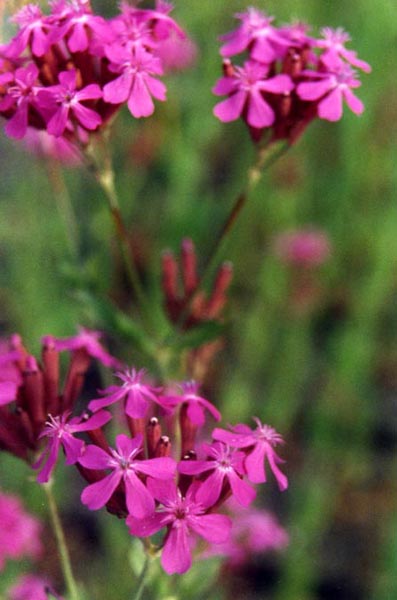
Annual or biennial of the Caryophyllaceae family, found in a large part of central and southern Europe, from the Iberian Peninsula to the Balkans and Asia Minor. It grows spontaneously on rocky grounds, stony embankments, roadsides, and sunny screes, at low and medium altitude, on generally calcareous and well-drained substrates.
The plant is upright, reaching 20 to 45 cm, with glaucous, smooth stems that are slightly sticky under the nodes — this stickiness, characteristic of the genus, prevents certain crawling insects from reaching the flowers without passing through winged pollinators. The leaves are oval-lanceolate, sessile, bluish-green, arranged in pairs along the stem.
The flowers, gathered in dense and rounded corymbs at the top of the stems, are bright pink to deep carmine pink, with five entire to slightly notched petals. The compact and colorful inflorescence contrasts with the discretion of the glaucous foliage.
In its natural habitat, its flowering extends from June to August. In cultivation, it generally occurs from June to September.
Easy to obtain from seed, it self-sows spontaneously from year to year in suitable conditions. It prefers a well-drained, poor to moderate soil, in full sun, and naturally integrates into rockeries, pavings, and natural-style gardens.