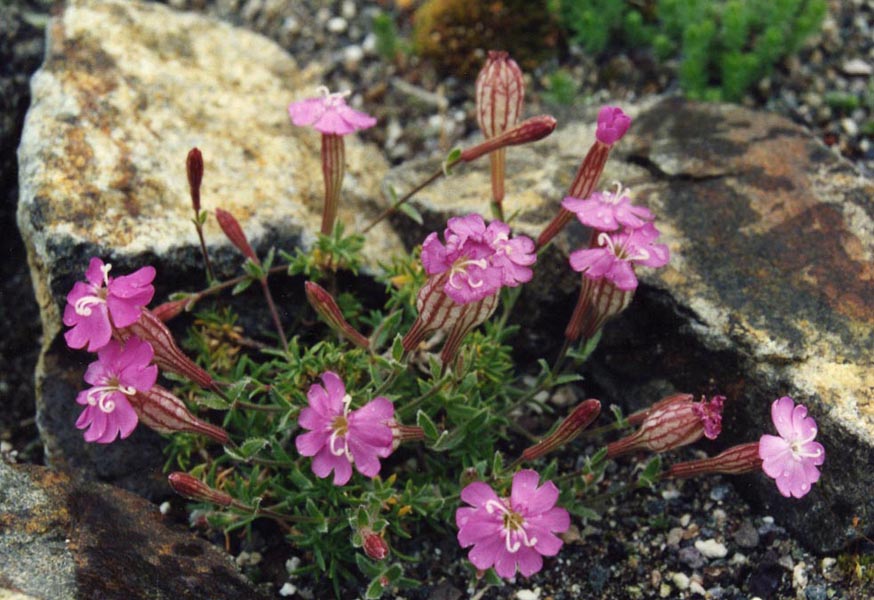
Perennial of the Caryophyllaceae family, native to central Anatolia, where it is associated with the mountainous regions of Turkey, notably the Argée region — the current Erciyes Dağı — from which its specific name is derived. It grows on rocks, scree, and high-altitude lawns in a dry and sunny continental environment.
It forms small low and compact tufts, with gray-green foliage, slightly pubescent, composed of narrow and spatulate leaves. The short flowering stems rise to 6 to 15 cm and each bear one to a few flowers. The calyx is one of the most remarkable elements of the plant: swollen and vesicular, it is traversed by dark purple longitudinal veins on a pinkish cream background, forming a very decorative veined network that precedes and accompanies the opening of the flowers. The petals, bright pink to magenta pink, are slightly notched, and the protruding stamens add to the liveliness of the whole.
In its natural habitat, its flowering extends from June to August depending on the altitude.
In cultivation, it requires full sun exposure, perfect drainage, and poor to moderately rich soil. It is suitable for dry rock gardens, troughs, and well-exposed slopes. It withstands summer drought but fears stagnant moisture in winter.