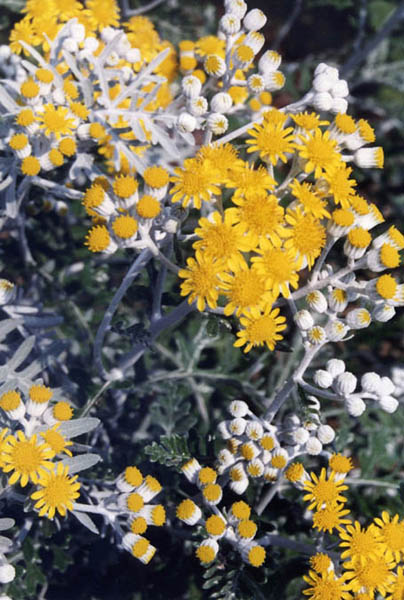
Perennial sub-shrub with a woody base, from the Asteraceae family, native to the western Mediterranean region, from the rocky coasts of the Iberian Peninsula to Italy, Sicily, and the Tyrrhenian islands. It is naturalized on several coastlines of Western Europe.
In its natural habitat, it colonizes maritime cliffs, coastal screes, open garrigues, and rocky calcareous or siliceous substrates, always in full light, at low altitude, often in direct contact with the sea spray.
It forms rounded and dense bushes 40 to 80 cm in height, with stems branching from the base. The most striking feature of the plant is its silvery white to ash gray foliage, densely covered with a woolly tomentum on both sides, with deeply lobed to pinnately lobed leaves. This persistent whiteness is an adaptation to the brightness and dryness of the coastal environment.
The bright yellow radiating capitula are gathered in large terminal corymbs. The flower buds, still wrapped in whitish involucres, offer a striking contrast with the open flowers. In its natural habitat, its flowering extends from May to July.
In cultivation, it requires a sunny exposure, perfect drainage, and poor soil. It tolerates limestone and sea wind, but poorly withstands cold and wet winters in continental areas. It is sometimes used as an annual or biennial in regions with severe frost.