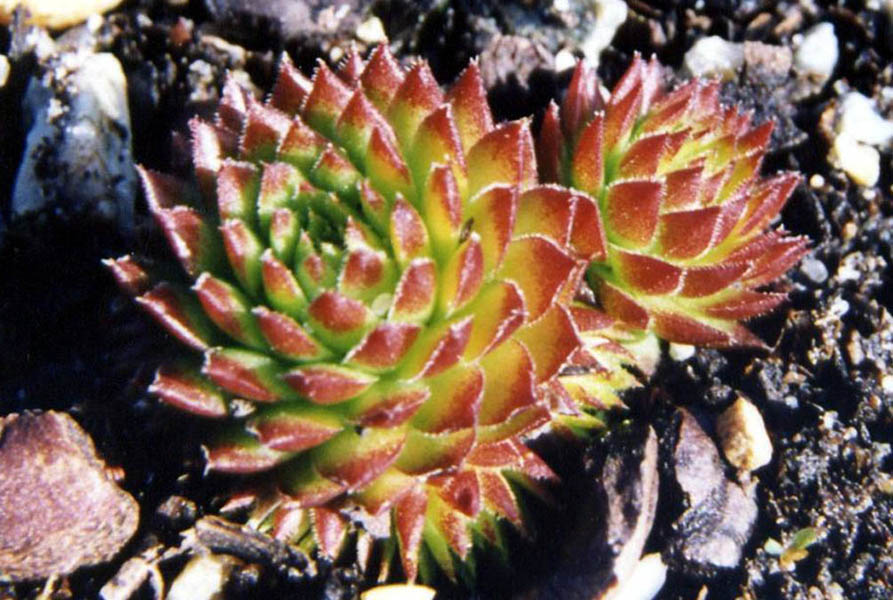
Succulent perennial of the Crassulaceae family. The epithet muralis, from the Latin murus, the wall, is a horticultural name whose exact botanical origin remains uncertain; it likely refers to a selected form or a garden hybrid particularly suited to cultivation on walls and rockeries. Its precise identity could not be verified in the reference registers consulted.
The rosettes, small to medium in size, are composed of lanceolate leaves with a mucronate tip, finely ciliated on the margins, arranged in a tight and geometric spiral. The plant quickly forms dense clumps through abundant stolonization.
The most remarkable feature of this material is its chromatic plasticity. The rosettes are a bright yellow-green to bright apple green in the shade or early in the season, and gradually turn to coppery reddish-brown to red-orange under intense sunlight or low temperatures. This color variation on the same clump, depending on the exposure of each rosette, produces a particularly lively visual effect.
Cultivation in full sun to partial shade, well-drained substrate, poor to moderately rich. Hardy and easy to propagate, this cultivar is suitable for dry stone walls, rockeries, and shallow containers.