A succulent perennial from the Crassulaceae family, this species is native to the Balkans, mainly Serbia and northern Macedonia, where it was first described in the early 20th century. It grows on sunny rocks and screes, at altitude, on various substrates. The species is named after the Serbian botanist Nedeljko Košanin, a pioneer in the study of Balkan flora.
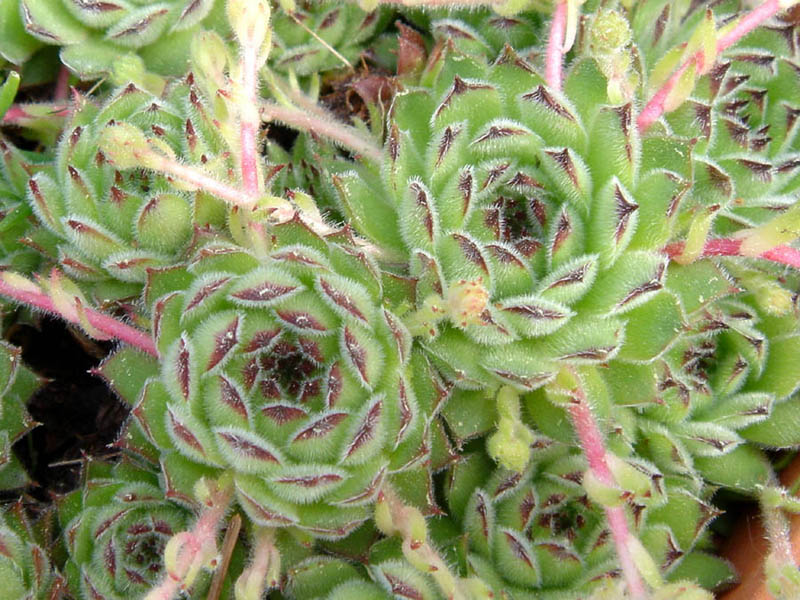
What immediately distinguishes S. kosanini in a collection is the length and color of its stolons. Slender, bright red to pink-carmine, covered with glandular hairiness, they extend in all directions well beyond the central tuft, bearing at their ends small daughter rosettes still closed that evoke tiny green pine cones. This spread, radiant, and colorful network gives the plant a truly unique silhouette both at rest and in full proliferation.
The rosettes are small, 2 to 4 cm in diameter, composed of short, oval leaves, medium to dark green, with a tip and sometimes a central brown-purple spot, bordered by a fine white hairiness. The tuft forms a dense cushion that quickly expands through active stolonization.
The flowers, pink to pink-purple, are borne on stems 8 to 15 cm tall. In its natural habitat, its flowering extends from June to August. In cultivation, it generally occurs in June-July.
Full sun, very well-drained substrate, minimal watering; hardy and easy to grow, it is perfectly suited for rock gardens, walls, and shallow containers where its stolons can spread freely.