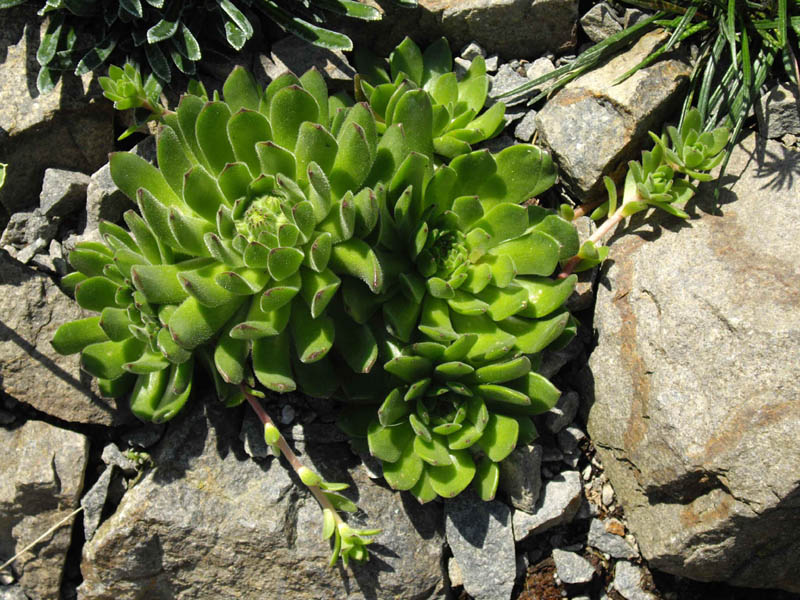
Succulent perennial of the Crassulaceae family, endemic to the western Alps, mainly on the Italian side and the inner valleys of Piedmont and the Aosta Valley. It colonizes siliceous rocks, scree, and cracks in sunny walls, generally between 1,800 and 3,000 meters, on acidic to neutral substrates.
The rosettes, medium to large in size, 4 to 10 cm in diameter, are composed of fleshy, broad, oval-spatulate leaves, a bright and shiny green, slightly glandular and sticky to the touch, with a mucronate tip often tinged with reddish-brown. This sticky texture, noticeable as soon as the foliage is touched, is one of the most immediate distinctive features of the species within the genus. The clumps develop into loose cushions, by rather long stolons.
The flowers are remarkable for their size, the largest in the genus according to Flora Europaea, which the name grandiflorum unambiguously announces. They are star-shaped, with numerous narrow petals, pale yellow to cream-white with a well-marked purplish-violet central vein, with a green heart and dark anther stamens. The inflorescence, dense and very abundant, crowns a 15 to 25 cm stem adorned with sheathing leaves.
In its natural habitat, its flowering extends from July to August. In cultivation, it generally occurs in June-July depending on altitude and exposure.
It is cultivated in full sun or slight partial shade, in a drained substrate rather acidic to neutral, low in lime. Hardy, it tolerates dry winter cold well but prefers to be protected from stagnant moisture in the cold season.