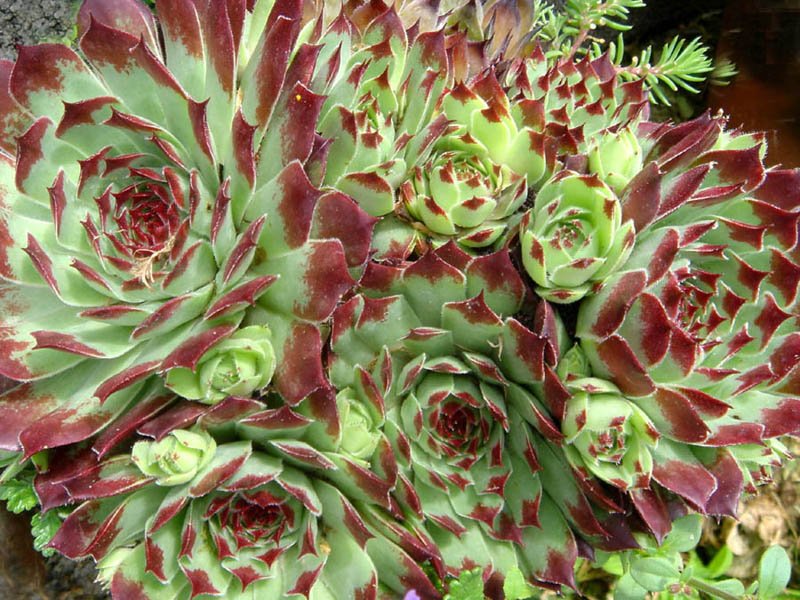
Succulent perennial of the Crassulaceae family, this ancient cultivar is derived from Sempervivum calcareum, a species endemic to the calcareous Alps of Southwestern France. 'Sir William Lawrence' is one of the oldest selected houseleek cultivars and is regularly found in specialized British and continental collections; it is listed in the Alpine Garden Society and the Scottish Rock Garden Club.
Its rosettes are medium to large, well-opened with a very regular spiral geometry. The foliage is a pale green to bright glaucous green, with tips and spots distinctly colored in red-brown to dark purple, covering the upper third to half of each leaf without invading the base. This light green and deep red-brown bicolor, clear and contrasting, gives the clumps a particularly pronounced graphic readability. The intensity of the coloration varies according to sunlight and season, often intensifying in summer and autumn. The clump develops into a dense cushion through stoloniferous multiplication, potentially forming large, very decorative patches over time.
The flowers are pink to pale pink, star-shaped, borne on fleshy stems 15 to 20 cm tall. In its natural habitat, the flowering of the type species extends from June to August; in cultivation, this cultivar generally blooms in June-July.
Full sun, very well-drained substrate preferably calcareous, limited watering, total hardiness. As with all houseleeks, the flowering rosette dies after fruiting, but the clump is abundantly renewed by daughter rosettes.