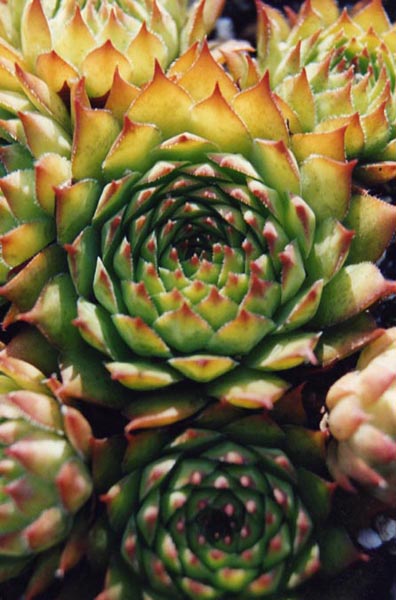
Succulent perennial of the Crassulaceae family, this species is endemic to the Southwestern Alps, mainly the Alpes-de-Haute-Provence, Hautes-Alpes, and Alpes-Maritimes, with a few known stations in the Ligurian Apennines. As its name suggests, it is strictly bound to limestone substrates, colonizing rocks, cliffs, screes, and old sun-exposed walls, generally between 500 and 2,000 meters.
The rosettes are large and well-opened, 4 to 8 cm in diameter, with broad, fleshy leaves, medium green to glaucous green, with a distinctly colored terminal tip in dark reddish-brown to dark reddish-purple — this striking contrast between the green body of the leaf and its dark tip is the most immediately distinctive feature of the species. The spiral geometry of the rosettes is particularly regular and pronounced.
The flowers are pale pink to whitish pink, star-shaped, gathered in corymbs on stems 15 to 25 cm tall. In its natural habitat, it blooms from June to August. In cultivation, it readily blooms in June-July.
It is cultivated in full sun, on a very drained and poor limestone substrate. It withstands summer drought well and is perfectly hardy. Its affinity for limestone distinguishes it from many other houseleeks and must be considered when composing the substrate.