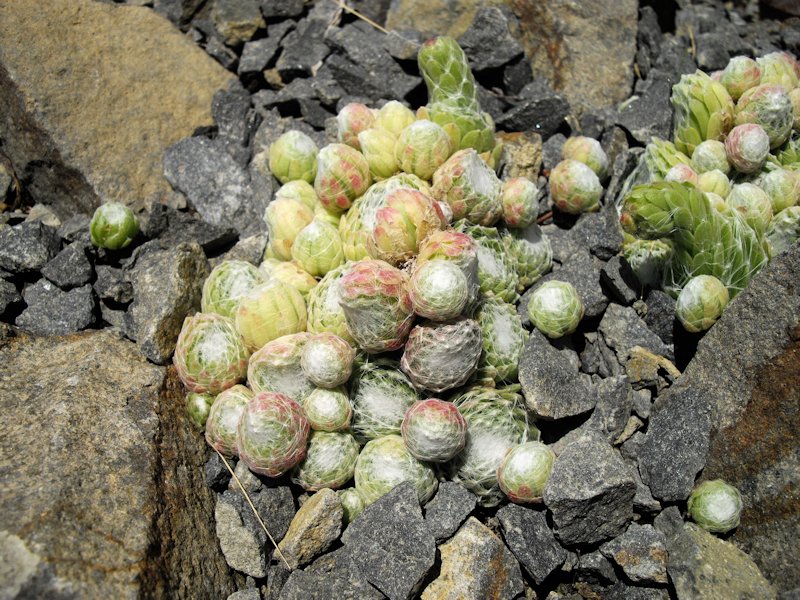
Succulent perennial of the Crassulaceae family, this subspecies is distinguished from Sempervivum arachnoideum subsp. arachnoideum by significantly larger rosettes, reaching 3 to 5 cm in diameter, and by an especially abundant and dense web, which envelops the rosettes in a very developed silvery white felt, sometimes to the point of making them almost unrecognizable under their veil. Its range mainly covers the western and central Alps, the northern Apennines, and the Pyrenees, on rocks, scree, and rocky alpine lawns.
The foliage is pale green to glaucous green, tinged with pink-red at the tips and on some undersides, with a generally lighter and milkier dominance than the type subspecies. The numerous and tight daughter rosettes are connected by short stolons and form compact, slightly spreading clumps.
The flowers are bright pink to carmine-pink, star-shaped, borne on fleshy stems of 8 to 15 cm. In its natural habitat, it blooms from July to August. In cultivation, it can bloom as early as June depending on exposure.
Same requirements as the type species: full sun, very well-drained and poor substrate, total hardiness.