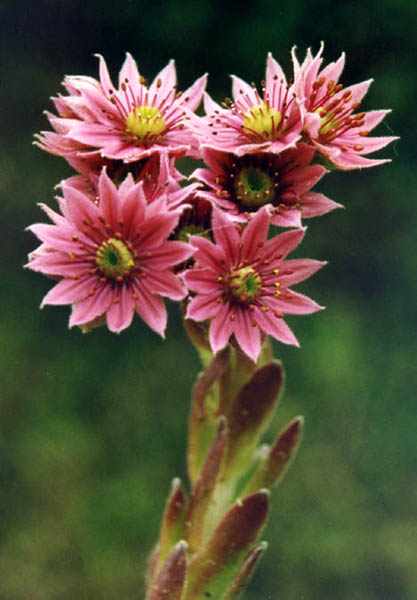
Succulent perennial of the Crassulaceae family, this houseleek is one of the most widespread and immediately recognizable in the Alps. Its natural range covers the Alps, the Apennines, the Pyrenees, and the Carpathians, where it colonizes rocks, scree, old walls, rocky slabs, and dry high-altitude lawns, generally between 1,500 and 3,000 meters, sometimes beyond.
It forms dense clumps of small fleshy rosettes, usually 1 to 3 cm in diameter, tightly packed together and connected by thin stolons. What distinguishes it at first glance is the network of whitish filaments, similar to a spider's web, which connects the tips of the leaves and more or less completely covers the center of each rosette. The intensity of this web varies according to individuals and populations. The leaves are medium green to reddish-green, often strongly tinged with reddish-brown, especially in intense exposure or dry conditions.
The flowering stems, fleshy and erect, reach 8 to 15 cm. They bear star-shaped flowers, bright pink to carmine pink, with numerous narrow petals and a yellowish center, gathered in terminal corymbs. In its natural habitat, its flowering extends from July to August. In cultivation, it can bloom as early as June depending on exposure and altitude. Like all Sempervivum, the flowering rosette dies after fruiting, replaced by daughter rosettes.
It adapts to the most ungrateful conditions — poor substrate, very drained, full sun, marked summer drought — and withstands harsh winters under snow without difficulty. In cultivation, it only requires well-drained, mineral soil, and a sunny exposure; it is equally suited to rock gardens, container gardens, or extensive green roofs.