syn. Sedum sieboldii
syn. Sedum sieboldii
Perennial of the Crassulaceae family, native to Japan, where it naturally grows on rocky cliffs and sunny stony slopes, mainly in the mountainous regions of Honshu and Kyushu. It is named after the German physician and botanist Philipp Franz von Siebold, who greatly contributed to the introduction of Japanese flora in Europe in the 19th century.
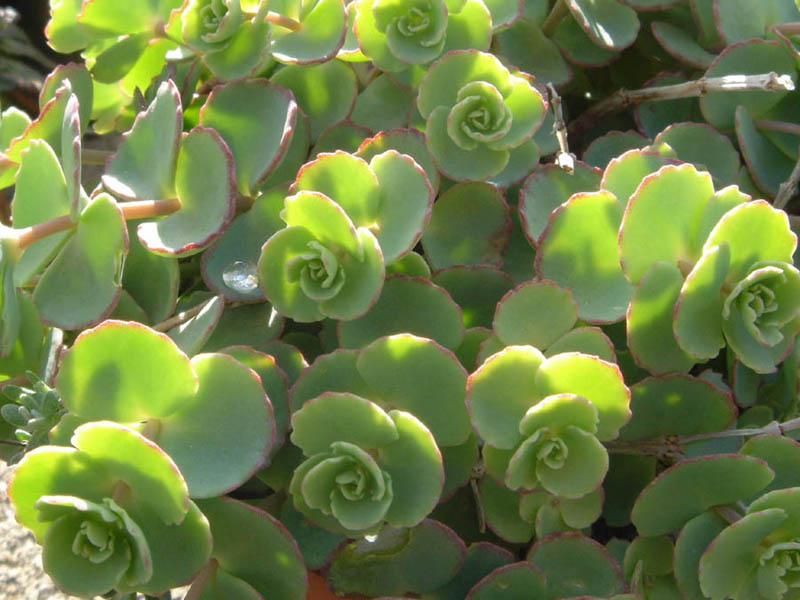
The plant develops trailing or spreading stems, starting from a central clump, reaching 20 to 30 cm in length. The leaves, arranged in threes in regular whorls, are round to kidney-shaped, fleshy, glaucous green to blue-green during the growing season, finely edged with red-pink. In autumn, the entire foliage gradually turns to carmine red to bright red, a spectacular coloration that precedes complete winter dormancy — the plant then disappears entirely above ground.
The flowers, pink to bright pink, are gathered in dense and rounded corymbs, very full, that terminate each stem. The star-shaped petals, stamens with purple anthers, and still-closed buds, visible in the photos, form flower heads of great density. In its natural habitat, its flowering extends from September to October; in cultivation, it occurs at the same time, which gives it particular interest at the end of the season.
In cultivation, it requires full sun and very well-drained soil, poor to moderately rich. It does not tolerate heavy and wet soils in winter during its dormancy. Excellent hardiness to very negative temperatures when drainage is ensured. It is equally suited to pot or trough culture as it is to rock gardens, where its trailing stems naturally follow the contours of the stones.