syn. Sedum sichotense
syn. Sedum sichotense
Perennial of the Crassulaceae family, native to the Russian Far East, specifically the Sikhote-Alin mountain range, in eastern Siberia and in regions bordering the Sea of Japan. It grows on rocks, rocky slopes, and well-drained embankments, in a continental climate with harsh winters and relatively humid summers.
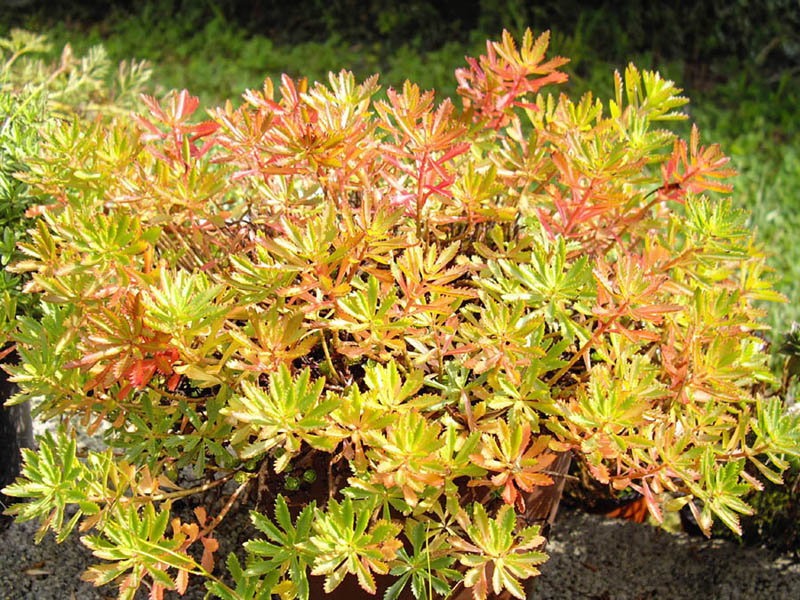
The plant forms spreading and bushy clumps, 15 to 25 cm in height, with branched stems bearing flat, oval to spatulate leaves, distinctly toothed on the margins, a bright green for most of the growing season. It is in autumn that this species reveals its main foliar attraction: under the effect of cold and shortening days, the entire foliage gradually transforms, passing through yellow-orange, bright orange then carmine red hues, before falling — a deciduous behavior quite exceptional in the genus, which brings this plant closer to certain deciduous shrubs than to an ordinary sedum.
The yellow flowers appear in summer; precise information on their morphology and exact period in the natural environment remains poorly documented in accessible sources and should be noted with caution. In its natural environment, its flowering likely extends from July to August.
In cultivation, it is very hardy, adapted to cold winters, and requires well-drained soil, in the sun or light partial shade. Its exceptional autumn coloration, just before the leaves fall, makes it a unique subject in collections of hardy succulent plants.