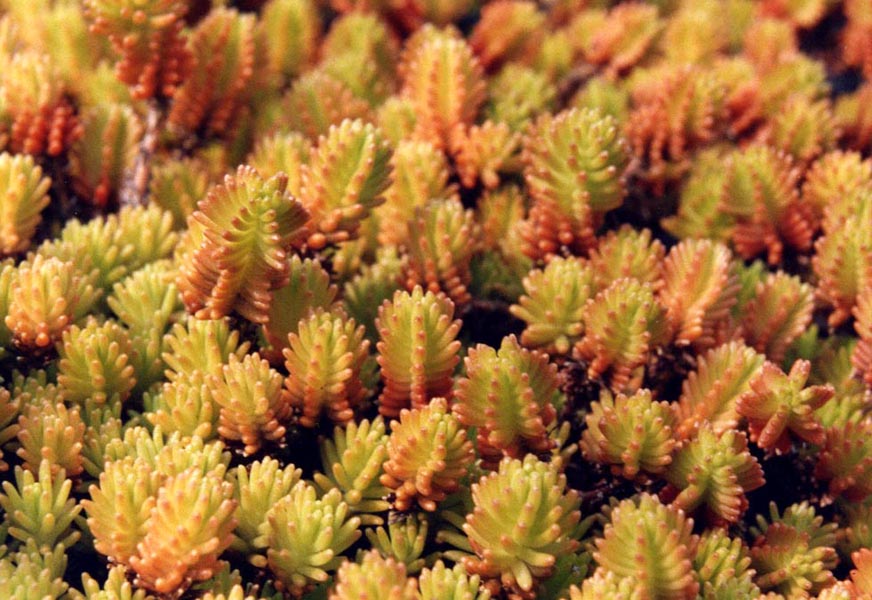
Perennial of the Crassulaceae family, widely spread in central and southern Europe, from the plains to the lower mountain levels. It occupies open and dry environments, rockeries, poor lawns, sandy slopes, old walls, and rocky outcrops, generally on well-drained calcareous or neutral substrates.
The plant forms creeping and dense carpets, 5 to 10 cm high, from which the flowering stems rise. Its most distinctive feature is the arrangement of the leaves on the sterile stems, arranged in six regular helical rows — hence the name sexangulare — giving them an almost geometric appearance, reminiscent of tiny spikes. The leaves are cylindrical, small, and blunt, medium green in favorable conditions, but turning distinctly coppery orange to bronze under intense sunlight or prolonged drought, a coloration that can invade the entire carpet and constitutes one of the unexpected attractions of the species outside of flowering.
The flowers, bright yellow to golden yellow, with five star-spread petals, are gathered in scorpioid cymes branched at the top of the upright stems. In its natural habitat, its flowering extends from June to August; in cultivation, it generally occurs in June-July.
It is frequently confused with Sedum acre, from which it is distinguished by its bland and non-irritating leaves, and by their more regularly spiral arrangement. Unlike S. acre, it is without acridity.
In cultivation, it requires full sun and a very well-drained soil, poor to moderately rich. Its hardiness is excellent and its ground-covering behavior makes it a reliable choice for paving gaps, green roofs, or dry rockeries.