Perennial of the Crassulaceae family, widespread around the Mediterranean basin, from the Iberian Peninsula to the Near East, also present in North Africa. It colonizes rocky areas, garrigues, cliffs, old walls, and sunny limestone scree, generally at low and medium altitudes, but can rise to about 1,500 meters in southern massifs.
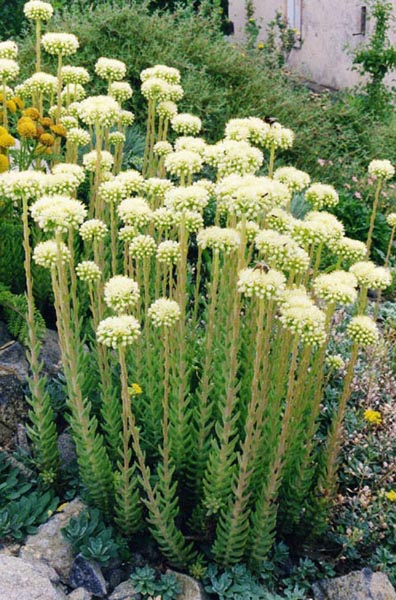
It is one of the most robust and architectural sedums of the Mediterranean flora. The sterile stems, upright to slightly spreading, reach 20 to 40 cm, densely covered with overlapping, fleshy, flattened leaves, glaucous to pale blue-green, with a slightly curved tip. At the time of flowering, the stalks rise further and bear large, flattened, highly branched corymbs, bringing together many small cream-white to pale yellow flowers, with narrow petals and prominent stamens, frequently visited by bees and foraging insects.
In its natural habitat, its flowering extends from June to August depending on altitude and exposure. In cultivation, it generally occurs in June-July.
The contrast between the glaucous and rigid columns of the foliage and the large light floral plates that crown them gives this species an immediately recognizable silhouette among the large sedums.
It is cultivated in full sun, in very well-drained soil, preferably limestone, and withstands prolonged drought. Perfectly hardy in regions with mild winters, it deserves protection or a sheltered location in colder climates.