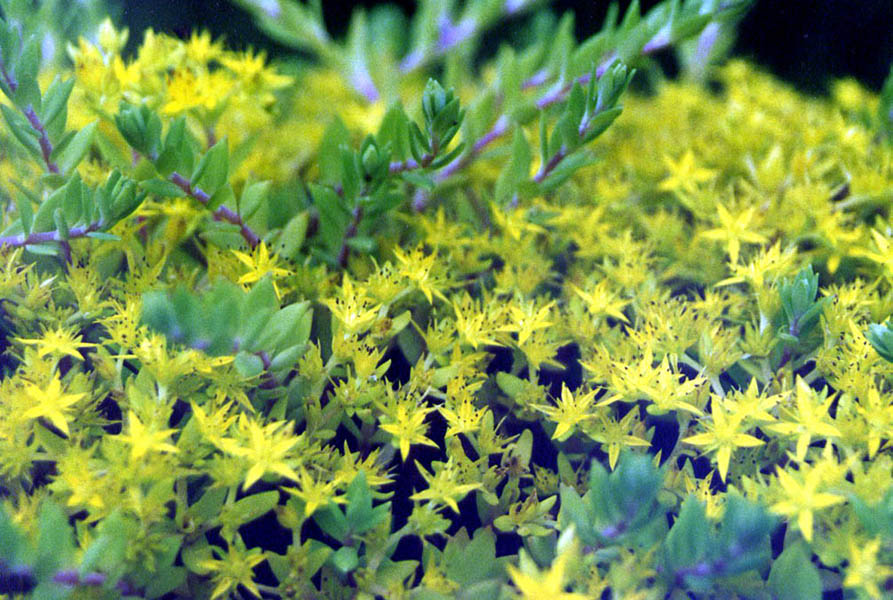
Perennial of the Crassulaceae family, native to China, Korea, and Japan, where it naturally grows in rocky areas, slopes, roadsides, and disturbed environments at low and medium altitudes.
The plant forms creeping and very dense mats, 5 to 10 cm high, spreading rapidly through its stoloniferous stems that root at the nodes upon contact with the soil. The leaves, arranged in threes in regular whorls along the stems, are oval-lanceolate, flat, from light green to medium green, fleshy but less thick than in many other sedums. This whorled arrangement is an immediately recognizable distinctive feature that sets it apart from the majority of species in the genus.
The flowers, bright yellow to lemon-yellow, with five star-shaped spreading petals, are produced in loose cymes at the top of the upright stems. In its natural habitat, its flowering extends from May to July; in cultivation under a temperate climate, it generally occurs in June.
In China and Korea, the plant is used in traditional medicine, notably as a hepatoprotective; modern pharmacological studies have been conducted on its extracts, although its therapeutic uses do not fall within conventional Western medicine.
It is cultivated in full sun to partial shade, in any well-drained soil. Its vigor and ability to root quickly make it an effective ground cover, to be monitored in small compositions.