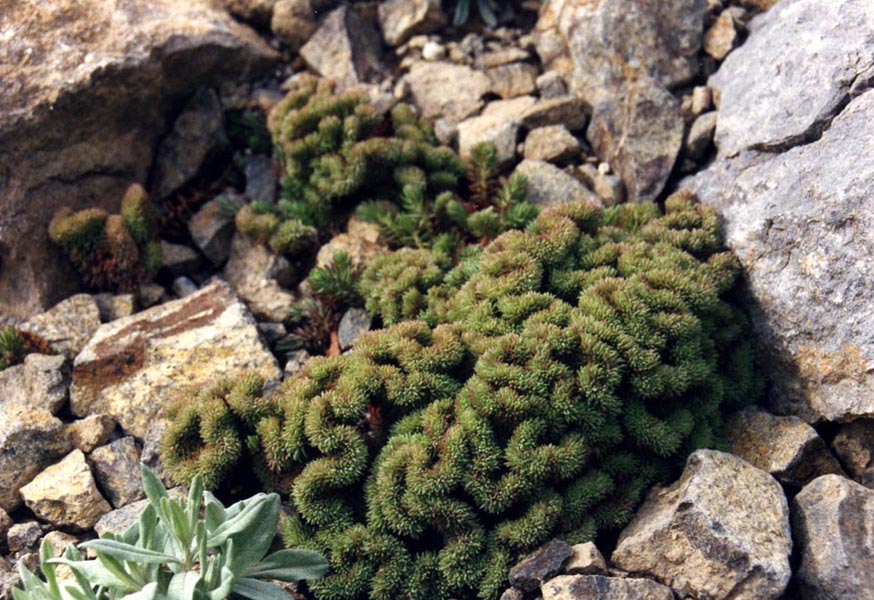
(Sedum reflexum 'Cristatum')
(Sedum reflexum 'Cristatum')
Crested form of Sedum rupestre, family Crassulaceae. It is not a selected cultivar in the classical sense, but a growth anomaly — fasciation — that affects the apical meristem and causes flattening and lateral multiplication of the stems instead of normal development. This phenomenon can occur spontaneously in many plant species; stable crested forms propagate exclusively by cuttings.
The habit is radically different from that of the type species. The stems, instead of developing cylindrically, flatten into wavy, contorted crests, reminiscent of ribbons or corals, densely covered with small glaucous to gray-green, fleshy, linear leaves. These crests stack and intertwine to form low, compact clumps with a very sculptural appearance, 5 to 15 cm in height depending on the individuals. Occasionally, some stems may revert to a normal habit, as can be seen in the first image; these branches should be removed to maintain the crested form.
The flowering is rare and irregular, with the crested stems producing few or no flowers. When it occurs, the flowers are yellow, identical to those of the type species.
In cultivation, the same conditions as for the type species are suitable: full sun, very well-drained soil, poor to moderately rich. The growth is slow, making it a collector's plant, appreciated for its unusual appearance in rock gardens and alpine troughs.