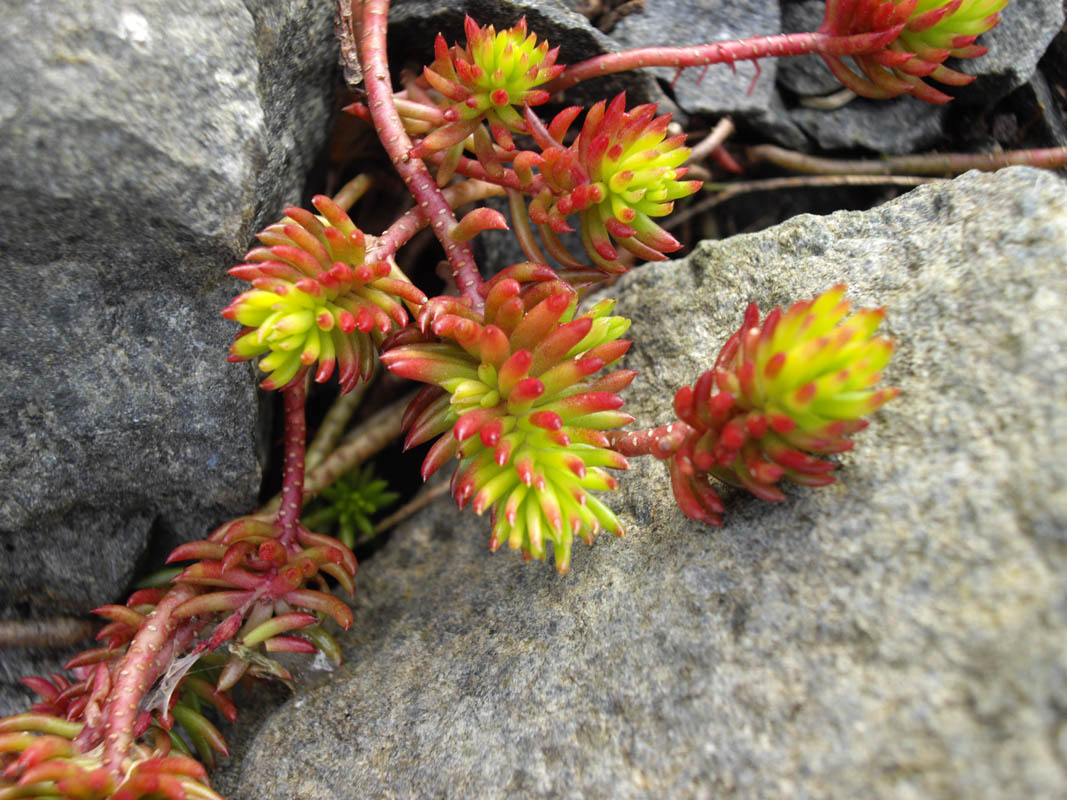
Perennial cultivar of the Crassulaceae family, selected from Sedum rupestre, the type species being native to Western and Central Europe. This cultivar was discovered in Croatia and introduced into horticultural commerce in the early 2000s; it has since spread widely in rock gardens and green roofs.
It forms creeping and dense mats, 8 to 15 cm in height, spreading widely through its stoloniferous stems. The foliage is its main peculiarity: the linear-cylindrical, fleshy leaves, arranged in tight spirals, display a bright chartreuse-yellow to golden-yellow under normal conditions, gradually turning bright orange then copper-red under the effect of winter cold or very sunny exposure and poor, dry soil. This range of colors, visible simultaneously on the same tuft depending on the exposure of the stems, is particularly striking at the end of the season and in winter.
The flowering, bright yellow, is identical to that of the type species. In its natural habitat, its flowering extends from June to August; in cultivation, it generally occurs in June-July, but remains secondary to the interest of the foliage.
It is cultivated in full sun, in any well-drained soil, poor to moderately rich. Direct exposure and drought enhance the orange and red colors. Hardy, vigorous, it is suitable for rock gardens, walls, containers, and extensive roofs, but its vigor requires monitoring in small spaces.