syn. Sedum reflexum
syn. Sedum reflexum
Perennial of the Crassulaceae family, widely spread in Western and Central Europe, from the Iberian Peninsula to the British Isles and Central Europe. It colonizes rocks, old walls, sandy slopes, screes, and dry lawns on acidic to neutral substrates, from sea level to lower mountain levels.
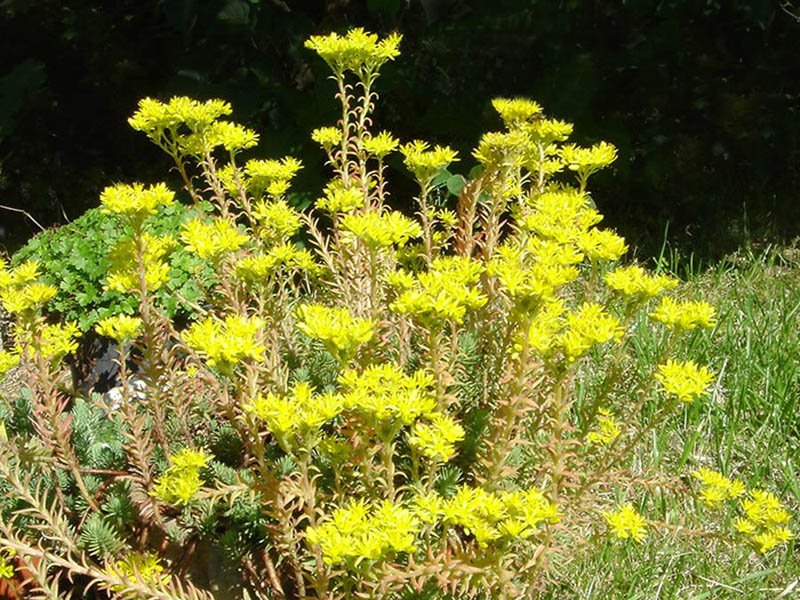
The plant forms dense, creeping mats, 15 to 25 cm high in bloom, from which erect flowering stems rise. The leaves are linear-cylindrical, glaucous to blue-green, arranged in tight spirals on the sterile stems; a well-naming characteristic of the species is the tendency of the tips of the sterile stems to curve downward before resuming growth. The flowering stems, on the other hand, bear spreading and upright leaves.
The flowers are star-shaped, with six or seven petals, a bright and clear yellow, grouped in terminal scorpioid cymes that unfold progressively. In its natural habitat, its flowering extends from June to August. In cultivation, it generally occurs from June to July.
Completely hardy and very frugal, it is suitable for rock gardens, green roofs, and sunny walls, in any well-drained soil. It can become invasive in small compositions.