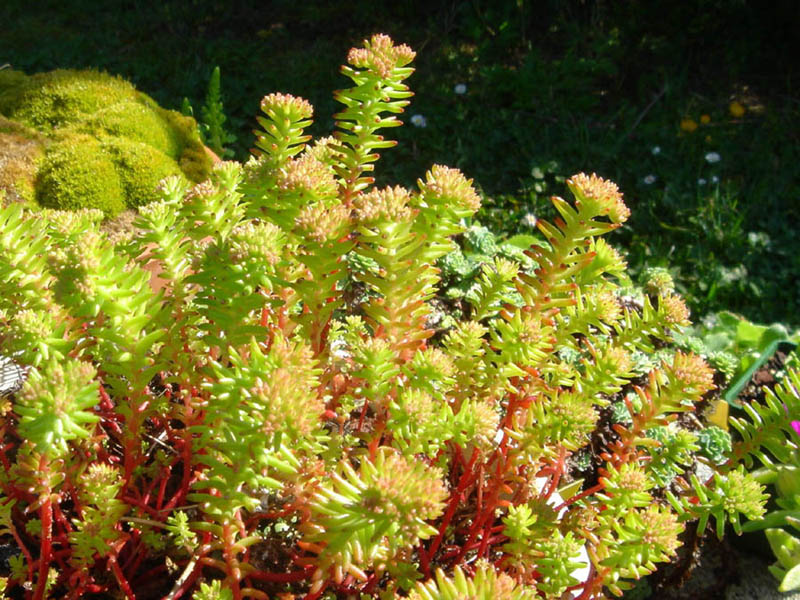
The plant forms dense and branched clumps, 10 to 20 cm in height, with upright to slightly spreading stems, a bright red to red-orange, particularly colored at the base. The leaves are linear, cylindrical, fleshy, arranged in tight whorls along the stems, a tender green to yellow-green that contrasts with the stem coloration. This combination of red stems and closely spaced whorled leaves gives the plant a fine and bushy texture, almost feathery, easily recognizable among narrow-leaved sedums.
The flowers are star-shaped, with four or five petals, a bright pink to lilac pink, gathered in terminal scorpioid cymes characteristic of the genus. In its natural habitat, its flowering extends from May to July. In cultivation, it occurs at the same period, and the entire plant then takes on a very decorative generalized pink hue.
Hardy and undemanding, it readily reseeds itself in well-drained and sunny rock gardens. It thus renews itself spontaneously from year to year without particular intervention. It is suitable for rock gardens, walls, and dry gardens, where its abundant pink flowering effectively enlivens late spring compositions.