syn. Sedum pilosum - Rosularia pilosa
syn. Sedum pilosum - Rosularia pilosa
Monocarpic perennial — or often behaving as a biennial — of the Crassulaceae family, native to the Caucasus and eastern Turkey, where it grows on rocks and high-altitude rocky slopes, in well-drained and poor substrates.
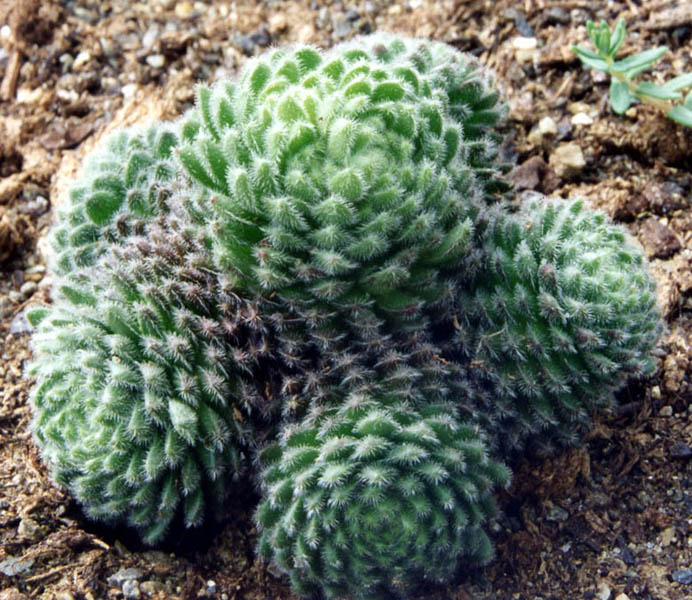
The plant forms small, dense, hemispherical rosettes, 2 to 4 cm in diameter, entirely covered with white, glandular hairs that give them a very characteristic woolly and silvery texture. The leaves are short, spatulate, tightly arranged in regular spirals, and their dense hairiness is the most immediately distinctive feature of the species within the genus — no other sedum from Europe or the Near East has such a developed indumentum. The plant spends most of its life in a vegetative state in this compact form before flowering and dying.
At the time of flowering, an erect stem of 5 to 10 cm rapidly develops from the central rosette, bearing a dense corymb of bright pink to carmine pink flowers, with five petals, a surprising color given the discreet nature of the foliage. In its natural habitat, its flowering extends from May to July depending on the altitude.
It requires perfect and absolute drainage and suffers from any stagnant moisture, especially in winter. Its cultivation is generally recommended in a trough or under cold shelter, to preserve the woolly foliage from prolonged rain. It self-seeds spontaneously and thus renews itself from one generation to the next in collections.