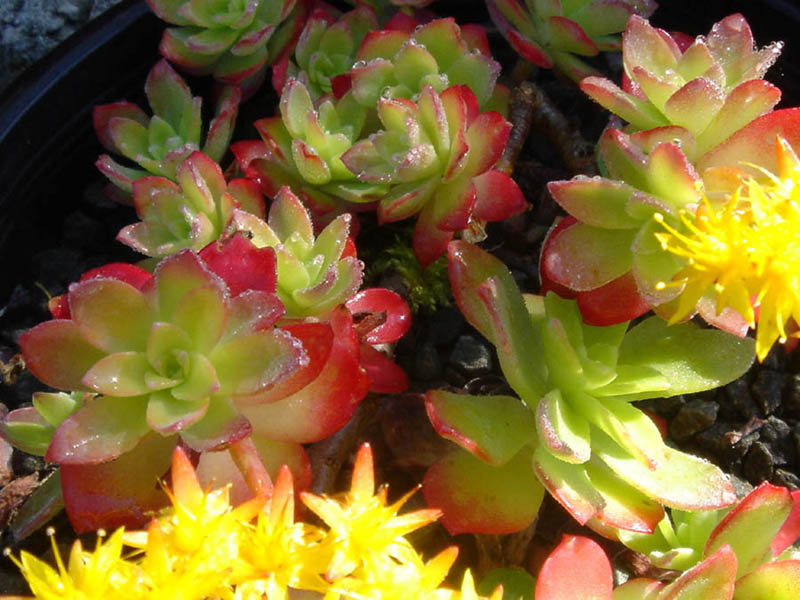
Perennial of the Crassulaceae family, native to northeastern Mexico, where it colonizes rocky walls, cliffs, and scree in warm and well-drained conditions. The species is named after the American botanist and explorer Edward Palmer.
The plant forms loose and spreading clumps, 10 to 15 cm in height, with branched stems bearing well-formed terminal rosettes. The leaves are spatulate, thick, and fleshy, from soft green to green-yellow, with margins and tips that turn bright pink-red to carmine red under the effect of sun and water or thermal stress. This green and red bicolor, particularly intense in the beautiful season, gives the rosettes a luminous and almost artificial appearance that immediately catches the eye.
The flowers are star-shaped, with five petals, in a bright and warm yellow, borne in loose and drooping corymbs on slightly arched stems. In its natural habitat, flowering occurs in winter to early spring. In cultivation under temperate climates, it is generally observed from March to May.
Its hardiness is limited and its cultivation in open ground is only possible in regions with mild winters, without prolonged frosts. In colder climates, it is grown in a trough under cold shelter or in a cold greenhouse in winter. It requires excellent drainage and full sun to fully develop its colors. Its early flowering and the contrast between the bicolored rosettes and yellow flowers make it a plant sought after by succulent collectors.