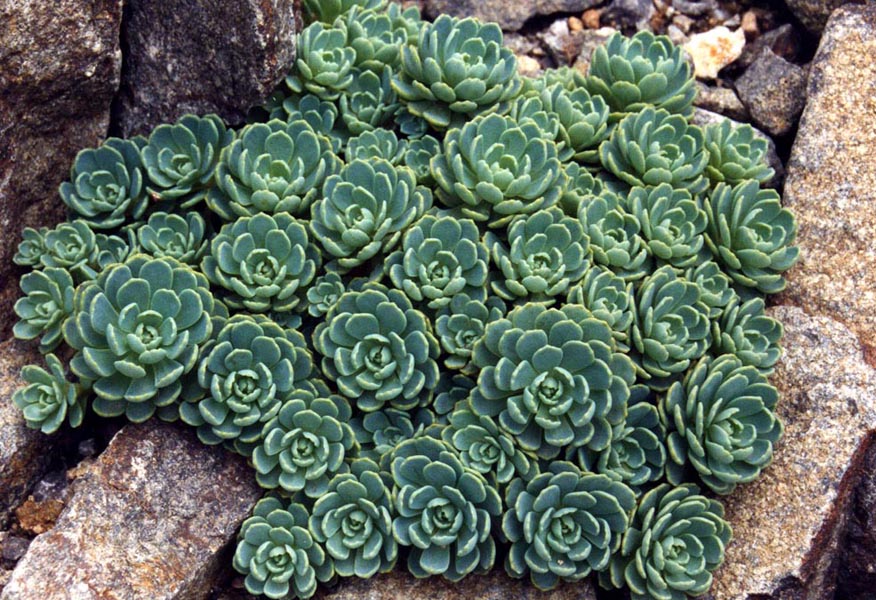
Perennial of the Crassulaceae family, native to Afghanistan and northern Pakistan, where it grows on rocks and high-altitude scree, in conditions of strong sunlight and extreme drainage.
The plant forms dense and regular mats, 5 to 8 cm in height, consisting of numerous fleshy rosettes tightly packed against each other. The leaves are spatulate, thick, from glaucous green to gray-green, slightly tinged with blue, with finely crenate edges towards the top. The entire cushion, seen from above, presents a geometric and orderly texture that evokes more a Sempervivum or a Rosularia than a classic sedum with cylindrical leaves. This imbricated rosette habit is the most distinctive feature of the species within the genus.
The flowers are white to cream-white, star-shaped, with five petals, carried in compact and short corymbs that barely emerge above the foliage. In its natural habitat, its flowering extends from June to July. In cultivation, it generally occurs at the same period, and the flowering mat then takes on a delicate white mossy appearance.
It requires perfect drainage and tolerates summer drought very well. Its hardiness is good under temperate climates. It is particularly suitable for troughs, sunny rock gardens, and wall crevices, where the regularity of its rosettes constitutes an ornamental pattern.