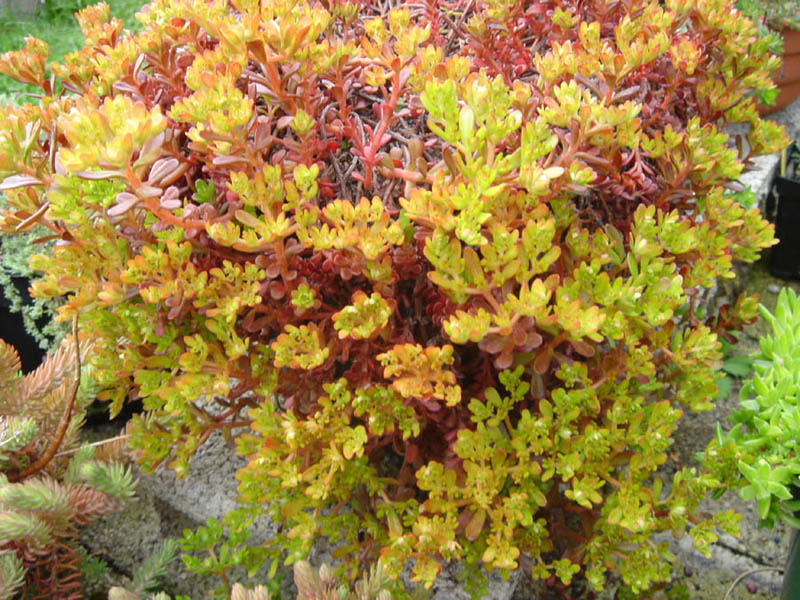
Perennial of the Crassulaceae family, native to Japan, where it grows in rocky areas and moist to cool wooded edges. The species is named after the Japanese botanist Tomitaro Makino.
The plant forms low, spreading clumps, 5 to 10 cm in height, with branched and semi-prostrate stems. The leaves are small, oval to spatulate, fleshy yet flexible, arranged in loose rosettes along the stems. Their color is one of the most remarkable aspects of the species in cultivation: depending on exposure, season, and degree of water or light stress, they range from bright yellow-green, orange-bronze to deep red-brown, often with multiple tones coexisting simultaneously on the same plant. This chromatic richness of the foliage almost eclipses the flowering.
The flowers are star-shaped, bright yellow, with five petals, grouped in dense and numerous terminal corymbs that largely cover the foliage at the time of anthesis. In its natural habitat, its flowering extends from June to July. In cultivation, it generally occurs at the same period.
It appreciates well-drained soil but tolerates slight coolness, unlike many sedums. Sunny exposure intensifies the coppery and red hues of the foliage. Its hardiness is adequate in temperate climates with moderate frosts. It is suitable for troughs, rock gardens, and containers, where its color variations provide persistent interest outside of flowering.