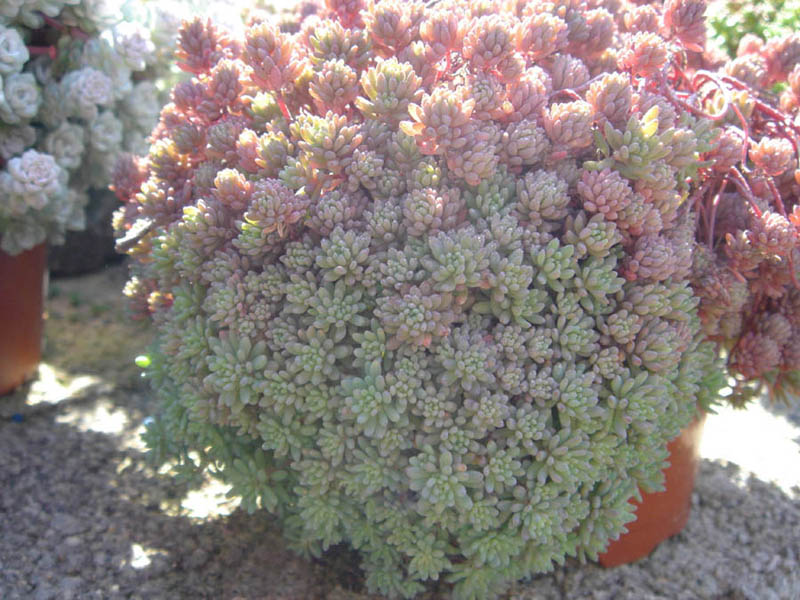
Cultivar of the Crassulaceae family, selected from the type species originating from Asia Minor. It shares with it the same cultural requirements and the same general habit, but is distinctly different by the color of its foliage.
The plant forms dense and very tight mats, 3 to 5 cm in height, with prostrate and branched stems bearing tiny, cylindrical, and fleshy leaves. Their base color is glaucous, gray-blue to gray-purple, and changes significantly depending on the season and exposure. In periods of stress, under the effect of cold or intense light, the leaves turn to a deep pink, then to red-brown, sometimes to shades close to plum or claret. This ability to traverse a wide range of colorations throughout the year, from gray-green to dark red, constitutes the main interest of the cultivar and clearly distinguishes it from the type species with bright green foliage.
The flowers are white, star-shaped, borne in small terminal corymbs. In its natural habitat, the flowering of the type species extends from June to July; in cultivation, this cultivar blooms at the same period.
It requires perfect drainage and full sun, conditions that favor the most intense expression of its colorations. It withstands moderate frosts. Rockeries, troughs, and dry stone walls are its preferred locations, where its seasonal chromatic variations can be fully appreciated.