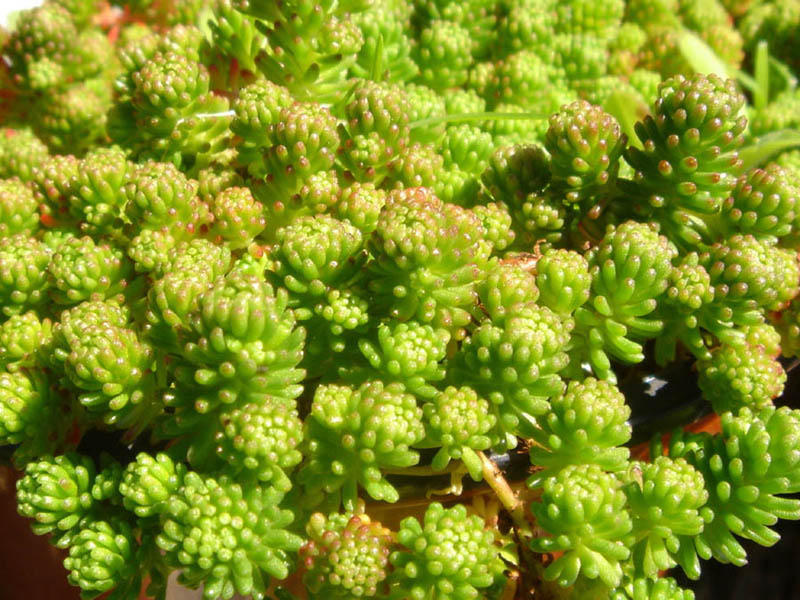
Perennial from the Crassulaceae family, native to Asia Minor, mainly from western and central Turkey, where it grows on rocks, screes, and rocky slopes at altitude, generally between 1,000 and 2,500 meters. It is a mountain species adapted to well-drained mineral substrates and significant thermal variations.
The plant forms dense and tight carpets, 3 to 5 cm in height, with very branched and prostrate stems. The leaves are tiny, cylindrical, fleshy, bright green to bright yellow-green, often tinged with reddish-brown at the tips during water stress or strong sun exposure. This bicolor coloration, visible on the leaf tips, is one of the most constant and immediately recognizable characteristics of the species.
The flowers are white, star-shaped, with five petals, grouped in small terminal corymbs slightly raised above the foliage carpet. In its natural habitat, it blooms from June to July. In cultivation, it generally occurs at the same period.
In cultivation, it requires perfect drainage and a sunny location; it tolerates poor and dry soils. Its hardiness is good under temperate climates, and it withstands moderate frosts without special protection. It is suitable for troughs, rock gardens, and paving interstices, where its dense foliage and reddish tips form a living carpet of great texture finesse.