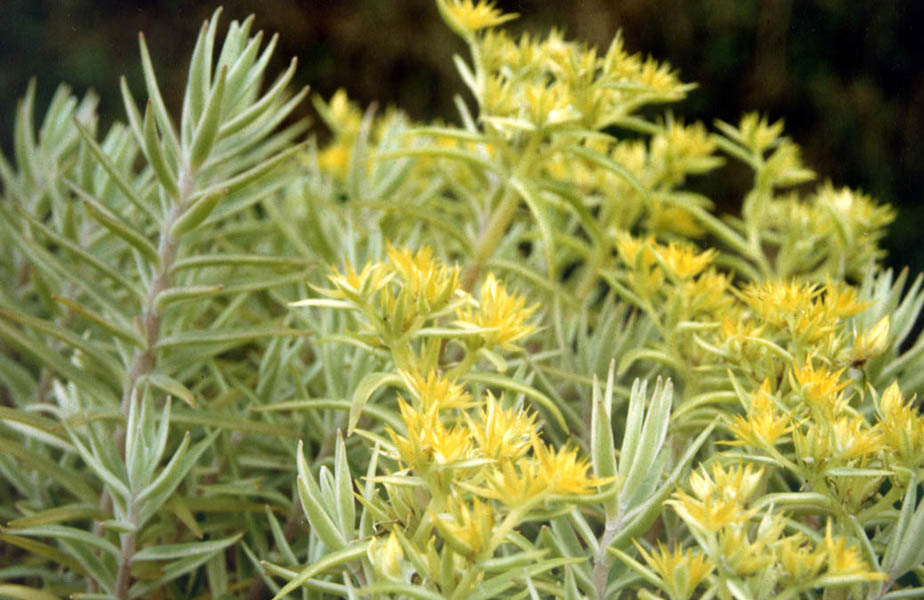
Perennial of the Crassulaceae family. The type species is native to Japan, China, and Korea, where it grows on rocks, slopes, and rocky edges in temperate environments. The variegated form 'Variegatum' is a horticultural cultivar selected and primarily distributed in Japan before being introduced to Europe and America.
The plant forms spreading to semi-erect clumps, 15 to 25 cm in height, with branched stems bearing leaves in whorls of three. The leaves are linear, narrow, and pointed, fleshy yet supple, with a bluish-green center bordered by a well-marked cream to ivory-white edge running the length of the leaf. This striped and luminous appearance, unusual in the genus, is the immediate distinctive feature of the cultivar and gives it a texture similar to some fine ornamental grasses.
The flowers are star-shaped, with five bright yellow petals, gathered in loose terminal corymbs that appear at the top of the stems. In its natural habitat, the flowering of the type species extends from May to June. In cultivation, it generally occurs at the same time under mild temperate climates.
In cultivation, this plant requires well-drained soil, in the sun or light partial shade. It does not tolerate frost and must be brought indoors in winter in cold climates. It finds its best place in pots or planters, which facilitates its sheltering as soon as the first frosts approach. Its persistent variegated foliage makes it an interesting plant all year round in regions with mild winters.