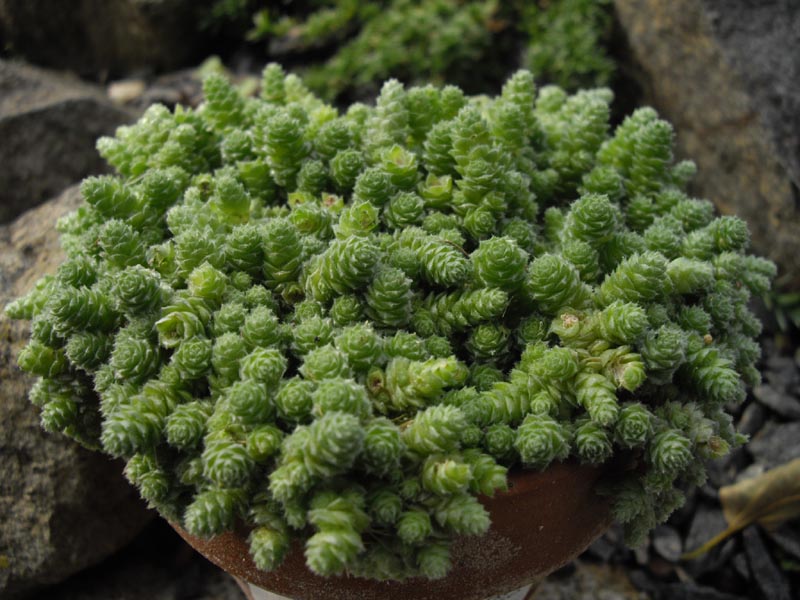
Perennial of the Crassulaceae family, native to Mexico, where it grows on high-altitude volcanic rocks and cliffs in the mountainous regions of Oaxaca and Puebla, generally between 2,000 and 3,000 meters. It is a tropical high mountain species, adapted to intense sunlight and cool night temperatures.
The plant forms very dense and prostrate cushions, literally creeping over the rocky substrate, only 2 to 4 cm in height. The stems are entirely covered with small, overlapping, oval, fleshy leaves, bright green to grayish-green, finely hairy and glandular, giving them a slightly downy texture and a characteristic matte appearance. This hairiness, clearly visible under a magnifying glass, immediately distinguishes the species from other dwarf sedums with cushion-like growth.
The flowers are solitary or very sparsely grouped, borne at the level of the foliage on short stems, star-shaped, with five petals of a bright and pure yellow. Their size is modest but their clear color contrasts sharply with the grayish-green of the cushion. In its natural habitat, its flowering mainly occurs in spring. In cultivation under our climates, it generally takes place from April to June.
In cultivation, this species requires perfect drainage, a poor mineral substrate, and winter protection against excessive moisture, as its frost hardiness remains limited and variable according to sources. It is cultivated in troughs or cold greenhouses in specialized collections, where its low growth and downy foliage make it a prized piece for enthusiasts of small Crassulaceae. It does not tolerate heavy soils or prolonged wet winters.