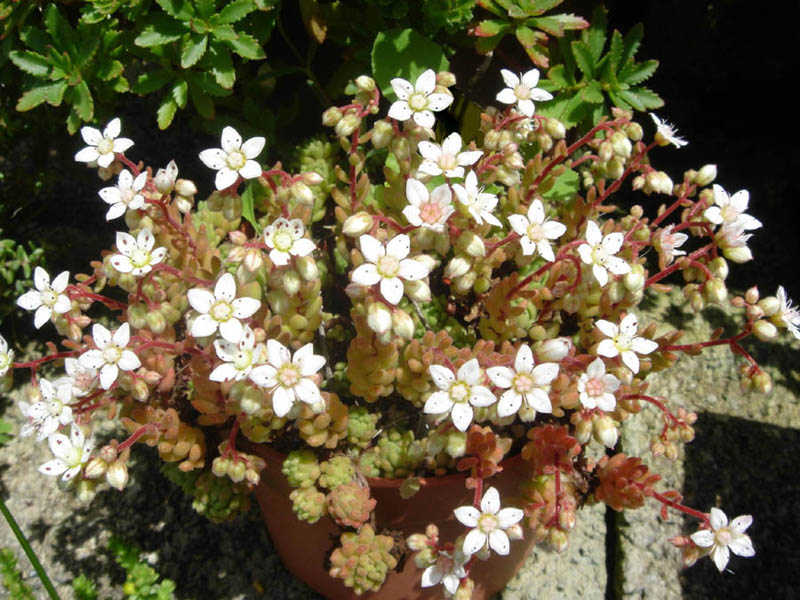
Perennial of the Crassulaceae family, native to the Iberian Peninsula, southern France, and northwestern Italy. It is a mountain species that grows on rocks, rock faces, and scree, often on siliceous substrate, between approximately 500 and 2,000 meters.
The plant forms loose to semi-compact tufts, 5 to 12 cm in height when in bloom, with branched stems that are erect to spreading. The characteristic that immediately distinguishes it from most other European sedums is its well-developed glandular hairiness, visible to the naked eye on the stems and leaves, giving the whole a velvety and slightly sticky feel to the touch. The leaves are small, ovoid to cylindrical, fleshy, yellowish-green to bronze-green depending on exposure, often tinged with orange-brown on the parts most exposed to the sun.
The flowers are star-shaped, generally with five petals, pure white to slightly pinkish white, each bearing a well-visible dark spot at the base of the petals, and pink to reddish carpels in the center. They are grouped in loose corymbs carried on thin, reddish, and hairy floral stems, which rise clearly above the foliage and spread out in all directions with an airy lightness. In its natural habitat, its flowering extends from May to July depending on altitude. In cultivation, it generally occurs in May-June.
In cultivation, it requires well-drained soil, preferably acidic to neutral, in full sun or very light partial shade. It is suitable for rock gardens, walls, and troughs, where its velvety foliage and abundant flowering particularly highlight it. Its hardiness is satisfactory in temperate climates, provided winter moisture excesses are avoided.