Perennial from the Crassulaceae family, native to the Caucasus, Anatolia, and the adjacent mountainous regions of the Near East. It colonizes rocks, cliffs, and rocky scree, generally at altitude, in perfect drainage conditions.
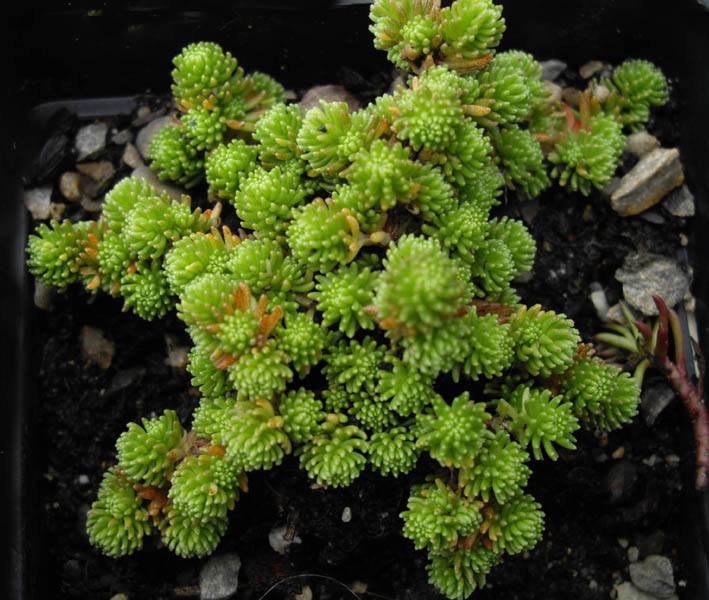
The plant forms dense and tight cushions, 3 to 6 cm in height, composed of numerous small, highly branched stems. The leaves are cylindrical to slightly flattened, small in size, bright green to light bright green, arranged in compact terminal rosettes that give the ends of the stems a characteristic appearance of small rounded heads, very regular and ornamental even when not in bloom. This tufted habit dotted with green pom-poms is one of the most immediately recognizable traits of the species.
The flowers are small, star-shaped, with five white to cream-white slightly pinkish petals, with anthers and carpels taking on reddish to salmon-pink hues that warm the entire inflorescence. The tight corymbs barely emerge above the foliage and cover the cushion with a multitude of small flowers at the time of blooming. In its natural habitat, its flowering extends from June to August depending on the altitude. In cultivation, it generally occurs in June-July.
In cultivation, it requires impeccable drainage, a poor to mineral substrate, and full sun exposure. It is perfectly suited to troughs and well-tended rock gardens, where its regular cushion habit and fresh green foliage advantageously distinguish it from other sedums of comparable size. Its hardiness is good in temperate climates, provided any stagnant moisture is avoided in winter.