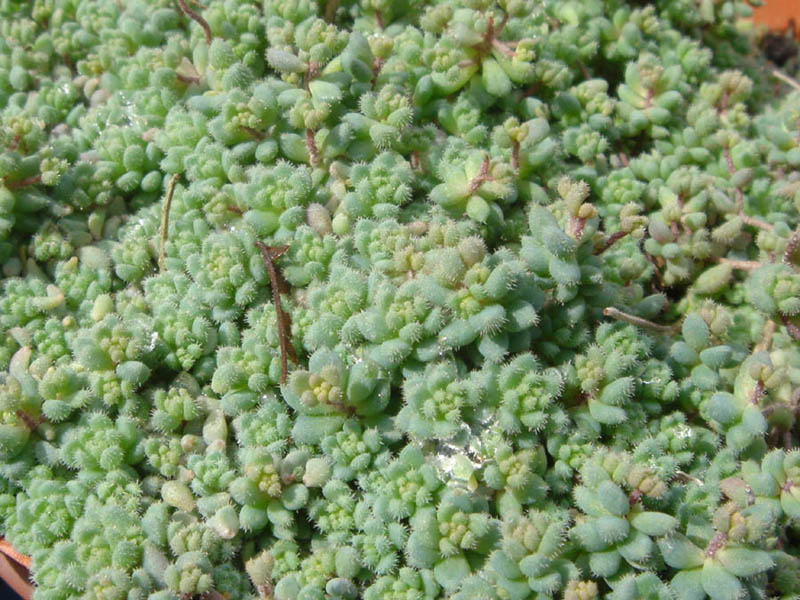
A perennial of the Crassulaceae family, this variety is distinguished from the type species by a significantly more developed glandular hairiness on all vegetative parts. Its range mainly covers the western Mediterranean basin, with populations reported in southern Italy, Sicily, and Sardinia in particular. The taxonomic status of this taxon remains debated according to authors and reference floras.
The plant forms dense and rounded cushions, remarkably compact, 3 to 6 cm in height, composed of small, highly branched stems bearing ovoid to globular, fleshy leaves, from glaucous green to light green, often tinged with pink on exposed parts. The most immediately visible feature that distinguishes it from the type form is the presence of glandular hairs clearly visible to the naked eye on the leaves and stems, which retain water droplets in shiny beads after rain, giving the plant a particularly striking shimmering appearance. As with the type species, the leaves detach at the slightest touch and root easily where they fall.
The flowers are star-shaped, with five white to pinkish-white petals, finely striped, bearing yellow anthers and characteristic reddish spots clearly visible in the center, gathered in loose corymbs borne on reddish floral stems 5 to 10 cm tall. In its natural habitat, its flowering extends from May to July. In cultivation, it generally occurs in June-July.
In cultivation, it requires very well-drained, poor soil, in full sun, sheltered from stagnant winter moisture. It is perfectly suited to troughs, rock gardens, and dry stone walls. Its complete hardiness remains to be verified depending on the provenance; protection against excessive winter moisture is preferable in rainy climates.