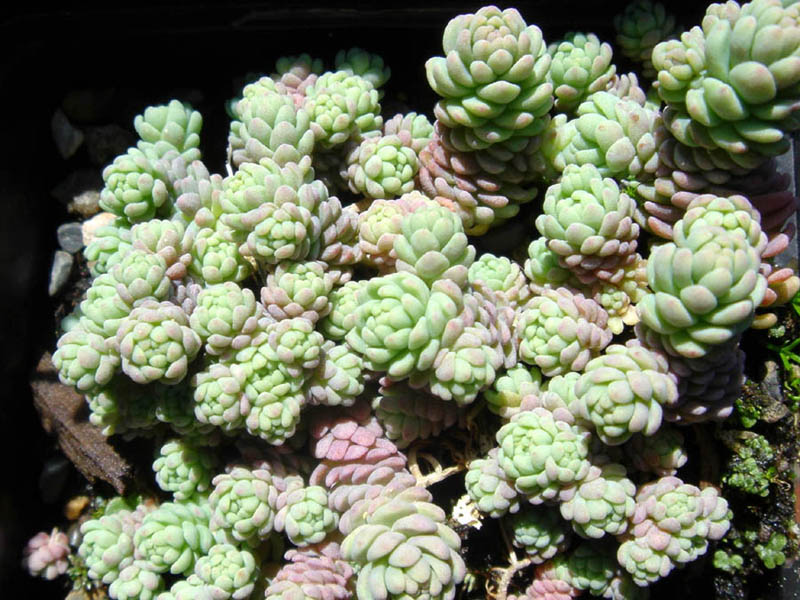
Perennial of the Crassulaceae family, widely spread in the Mediterranean basin and southern and central Europe, present from the Iberian Peninsula to the Balkans and Asia Minor, as well as in North Africa. In France, it is common in southern regions and locally ascends on limestone substrates to altitude, where it can be found up to about 1,800 meters.
It colonizes sunny rocks, old walls, limestone cliffs, and stable scree, insinuating itself into the smallest cracks with remarkable ease. The plant forms dense, tight clumps 3 to 5 cm high, composed of numerous small branched stems bearing opposite, ovoid to almost globular leaves, very fleshy, with a characteristic glaucous blue-green, often tinged with pink to purplish when the plant is exposed to the sun or under water stress. To the touch, the leaves are slightly glandular, barely perceptibly. At certain times, they detach with great ease at the slightest contact and can spontaneously root where they fall, which partly explains the plant's ability to quickly colonize surrounding interstices and cracks.
The flowers are small, star-shaped, with five white petals streaked with a central pink to pink-lilac line, borne on slender floral stems 3 to 8 cm that rise above the vegetative mat. When the plant blooms abundantly, the effect of a multitude of small white stars dotting a bluish cushion is particularly delicate. In its natural habitat, its flowering extends from May to July depending on altitude and exposure. In cultivation, it generally occurs from June to July.
The species is very morphologically variable, with several subspecies recognized according to authors, differing notably in leaf size, degree of glaucescence, and flower hue. This variability explains the numerous forms circulating in rock garden plant collections.
In cultivation, it is remarkably easy in perfectly drained soil, poor to ordinary, in full sun. It withstands prolonged summer drought and is fully hardy under most temperate climates. It spontaneously reseeds in cracks and interstices of walls and pavements, and the natural fall of leaves often suffices to ensure its propagation without any intervention. Excellent for troughs, dry stone walls, and limestone rock gardens, it naturally associates with other small-sized sedums and encrusted saxifrages.