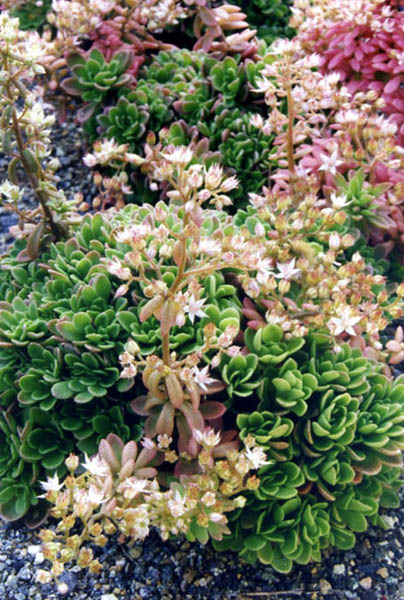
Fasciated form of Sedum cepaea L., annual or biennial from the Crassulaceae family. Fasciation is a growth anomaly, of genetic or accidental origin, in which the apical meristem flattens and widens into a ribbon instead of developing normally into a point. It occurs sporadically in nature in many plant species and can be fixed and multiplied by cuttings in some of them.
In this form, the stems and terminal rosettes are flattened, widened, and seemingly fused laterally to each other, forming wavy crests and dense fans that give the plant a quite unusual architecture. The foliage retains the characteristics of the type species, with small oval to spatulate, fleshy leaves, fresh green to olive green, but their arrangement in multiple fused rosettes creates a very particular texture effect, evoking in places certain cacti or euphorbias with a fasciated habit.
The flowers, when they appear, are identical to those of the type species, small and starry, pinkish-white, borne on floral stems that may themselves exhibit fasciated deformations. In its natural habitat, the flowering of the type species extends from May to July. In cultivation, this form generally blooms from June to August.
Like the type species, it is cultivated in well-drained, poor to ordinary soil, in sun or light partial shade. Its longevity in cultivation depends on the stability of the fasciated anomaly and the ability to maintain the form by cuttings, as sowing does not guarantee the transmission of the trait. A botanical curiosity above all, it interests collectors of monstrous forms and enthusiasts of unusual succulents.