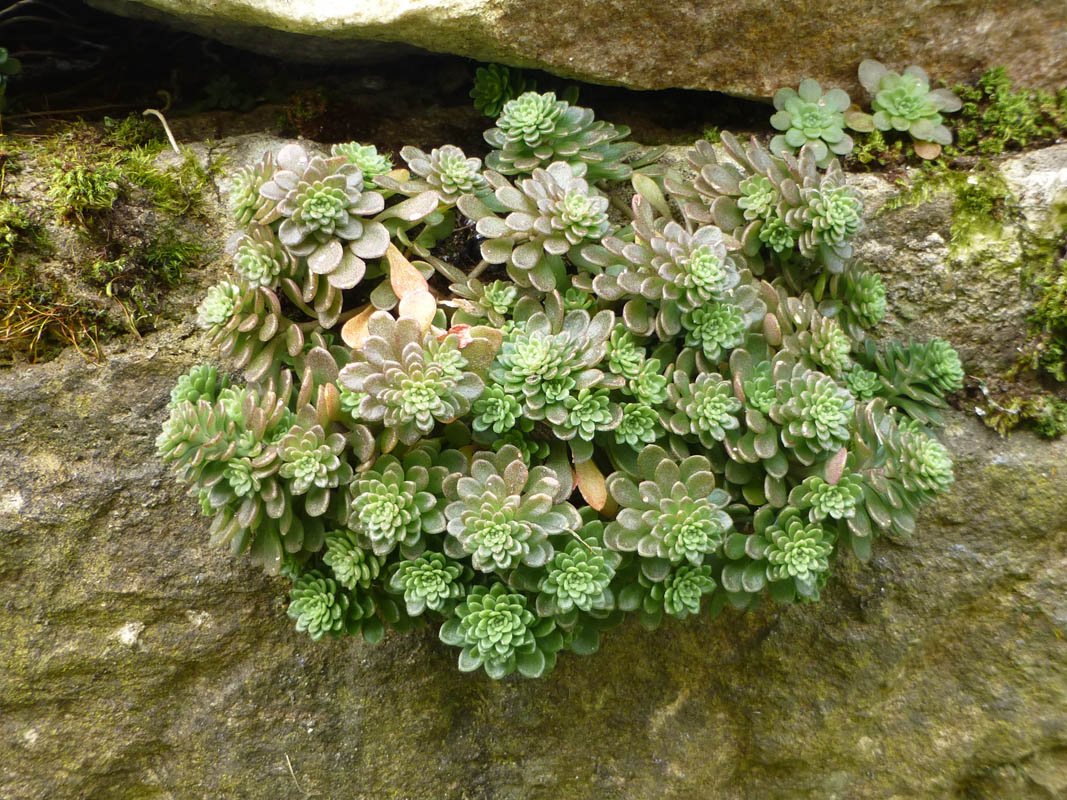
Annual or biennial of the Crassulaceae family, present in a large part of southern and central Europe, from the Iberian Peninsula to the Balkans, as well as in North Africa. In France, it is well represented in the southern and Atlantic regions, extending locally quite far north.
In its natural habitat, it occupies shaded rocks, old walls, wooded stony embankments, edges of clear undergrowth, and fresh scree, generally at low and medium altitude. It appreciates substrates indifferently calcareous or siliceous, provided they are well-drained, and tolerates partial shade better than most European sedums.
The plant has a particularly original habit in the genus. The stems, initially upright then quickly arched to pendulous, reach 10 to 25 cm and bear leaves arranged in a very characteristic manner. The lower and middle leaves are flattened, oval to spatulate, fleshy but not cylindrical, medium green to olive green, often tinged with bronze to reddish depending on exposure. The upper leaves of the flowering stems are narrower and more sessile. At the end of the cycle, the entire plant gradually turns to reddish-brown then coppery red, giving it a very particular aspect, almost autumnal, even in the middle of summer.
The flowers are small, starry, with five white petals streaked with a pinkish to reddish central line, borne in very branched and loose cymes that occupy the end of each stem. The entire inflorescence is light, airy, with an unusual delicacy for a sedum. In its natural habitat, its flowering extends from May to July depending on the region and exposure. In cultivation, it generally occurs from June to August.
Species with a short cycle that self-seeds spontaneously when conditions suit it, it requires no particular intervention once established in a drained, ordinary to poor soil, in the sun or in light partial shade. Its relative tolerance to shade clearly distinguishes it from the majority of sedums and makes it an interesting subject for the cool corners of a rock garden or the base of a wall facing east.