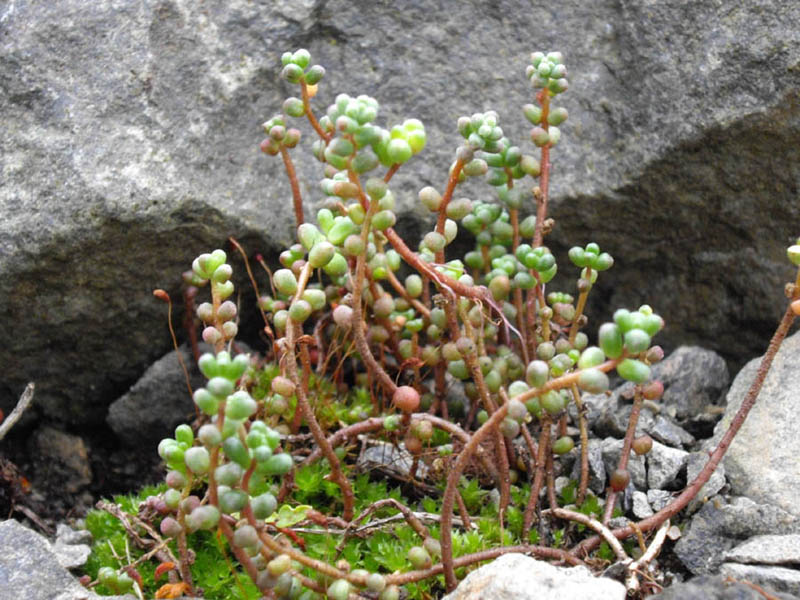
Perennial of the Crassulaceae family, native to the Iberian Peninsula, southern France (Pyrenees, southern Massif Central), and northwestern Africa. It is one of the most finely miniaturized sedums of the western European flora.
In its natural habitat, it colonizes siliceous rocks, granitic outcrops, and exposed fine scree, from the collinean to the alpine levels, sometimes beyond 2,500 meters in the Pyrenees. It is strictly calcifuge and seeks acidic, well-drained substrates, often in very narrow crevices or on barely colonized rocky slabs.
It forms extremely compact and dense mats, 3 to 6 cm in height, consisting of highly branched stems bearing tiny fleshy, almost globular leaves, arranged in four regular rows that give the stems a curiously quadrangular and beaded appearance. The foliage color is particularly variable depending on exposure and season, ranging from bluish glaucous green to intense reddish-brown, sometimes almost carmine on the most exposed plants, with often pruinose tips of a characteristic blue-gray.
The flowers, with five petals, are pure white to slightly pinkish white, with a pink or reddish keel on each petal giving them a very delicate striped appearance. They are borne on fine, erect, reddish stems that clearly emerge above the mat. In its natural habitat, its flowering extends from June to August depending on altitude. In cultivation, it generally occurs in June-July.
In cultivation, this species proves delicate and requires particular attention. It imperatively demands an acidic, very well-drained substrate, poor in organic matter, in full sun. It tolerates neither limestone, excessive watering, nor stagnant humidity at the collar. Winter is the most critical period, as the combination of cold and humidity is often fatal under oceanic or humid continental climates. Cultivation under an airy cold frame, or in a slightly heated alpine greenhouse with very reduced watering from November to March, gives the best results. A trough on pure granitic substrate, sheltered from winter rains, remains the safest setting to sustainably appreciate the formal precision and changing colors of this collector's sedum.