Perennial of the Crassulaceae family, native to the western Atlantic Europe, from the British Isles and Ireland to the Atlantic coasts of France, the Iberian Peninsula, and northern Morocco.
In its natural habitat, it colonizes siliceous rocks, coastal cliffs, moors, old walls, and screes, from sea level to modest altitudes. It is strictly calcifuge and shows a clear preference for acidic, sandy, or granitic substrates, often in windy and exposed conditions.
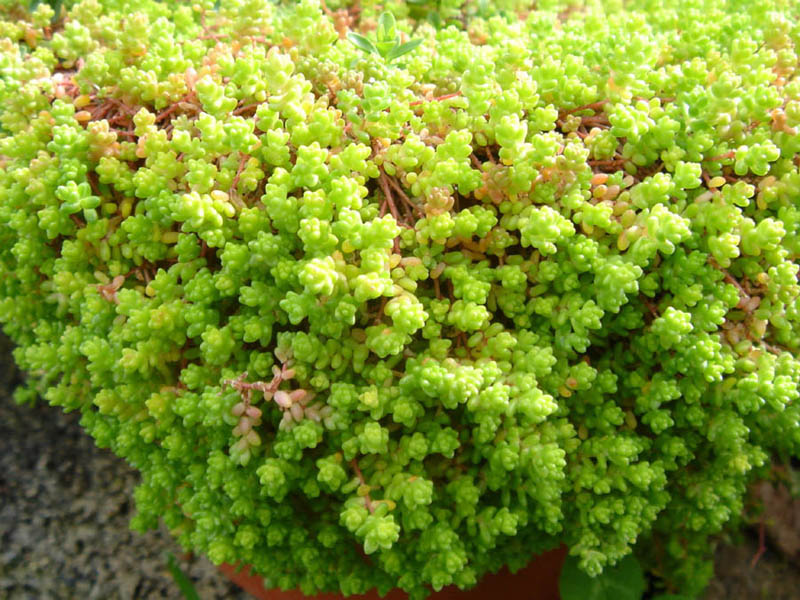
It forms dense and tight mats, 3 to 8 cm high, of bright green to bright yellow-green, consisting of highly branched stems bearing tiny fleshy, ovoid, alternate leaves, often tinged with pink or reddish-brown on exposed parts. The texture of the mat, granular and compact, is particularly attractive outside of flowering.
The flowers, with five petals, are pure white to slightly pink, with pink or reddish anthers giving them a delicate starry appearance. They are borne in loose cymes on short erect stems that emerge from the mat. In its natural habitat, its flowering extends from June to August. In cultivation, it generally occurs from June to July.
In cultivation, it imperatively requires an acidic or neutral, well-drained, poor substrate in full sun. It tolerates neither limestone nor waterlogging. Perfectly hardy under Atlantic climates, it finds its place in troughs on acidic substrate, granitic rock gardens, and extensive green roofs.