Perennial of the Crassulaceae family, a strictly mountain species, native to the Alps, the Pyrenees, the Apennines, and the Carpathians.
In its natural habitat, it occupies moist rocks, fine scree, snow hollows, and acidophilous alpine meadows, generally between 1,800 and 3,000 meters, on siliceous or slightly acidic substrates. It favors cool locations, often north-facing or partially shaded, where snow persists late.
It forms small, very low creeping mats, rarely more than 3 to 5 cm in height, consisting of thin, branched stems bearing tiny fleshy leaves, oval to almost cylindrical, in a tender green to yellowish-green, often tinged with reddish-brown or pinkish-purple under exposure or stress conditions, giving them a characteristic bicolored appearance.
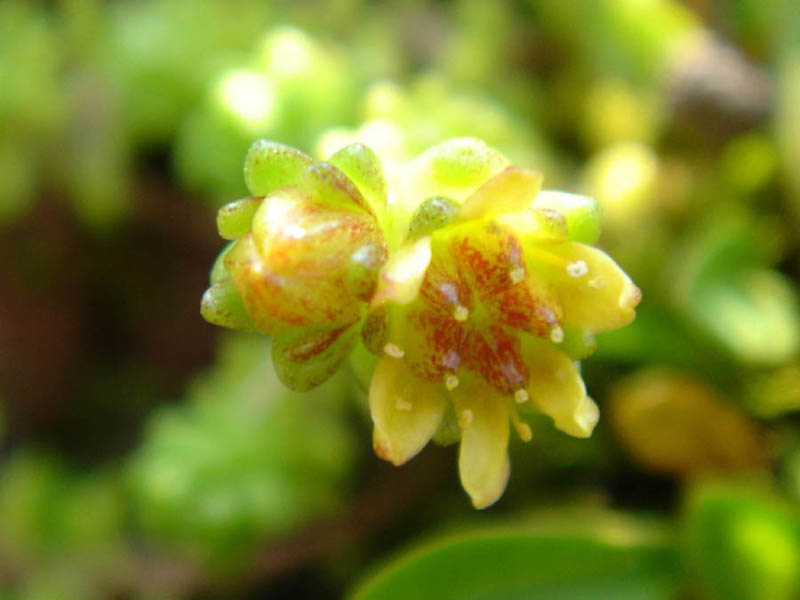
The flowers are small, with five pale yellow to yellow-green petals, often marked with reddish-brown streaks or spots that give them an unusual marbled appearance among European sedums. They are grouped in very compact and short terminal cymes, almost sessile on the foliage. In its natural habitat, its flowering extends from July to August depending on the altitude.
In cultivation, it requires a fresh to slightly moist, well-drained, acidic to neutral soil, low in lime, in a semi-shaded exposure. Unlike most cultivated sedums, it does not tolerate prolonged drought or calcareous substrates. However, like many snow hollow plants accustomed to wintering under snow cover, it poorly tolerates stagnant winter moisture in cultivation; light protection or shelter under a cold frame is advised. It is suitable for alpine collection troughs, troughs, and moist rock gardens with a mountain character.