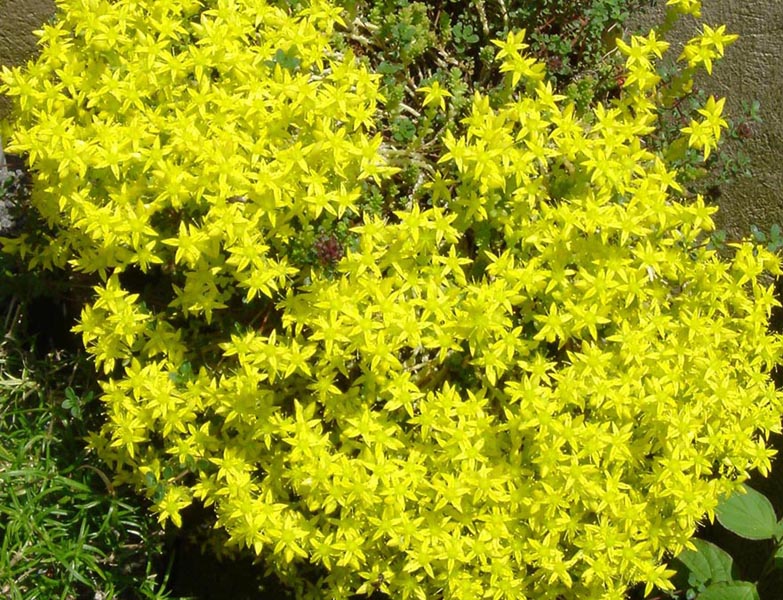
Perennial of the Crassulaceae family, widely spread in Europe, Western Asia, and North Africa, naturalized in many other regions of the world.
In its natural habitat, it colonizes the harshest environments: rockeries, walls, roofs, sands, dry lawns on limestone or silica, exposed slopes, and rock crevices, from sea level to altitudes sometimes exceeding 2,000 meters in European massifs.
It forms dense, creeping mats, rarely taller than 5 to 10 cm, consisting of tightly branched stems, entirely covered with small, fleshy, oval leaves, bright green, arranged in a spiral and interlocking with each other. This succulent foliage persists in winter, sometimes taking on slightly reddish hues in cold weather.
The flowers, bright yellow to bright yellow-green, are star-shaped with five petals and cluster in terminal cymes that invade the mat to the point of almost entirely masking the foliage. In its natural habitat, flowering extends from May to July depending on altitude and exposure; in cultivation, it generally occurs in May-June.
Its specific epithet, acre, recalls the acrid and burning taste of its leaves, due to alkaloids; the plant is considered slightly toxic and was once used in folk medicine in very small doses, notably as an external vesicant, a use now abandoned.
In cultivation, it shows absolute frugality: any well-drained, poor soil in full sun suits it. It withstands prolonged drought, skeletal substrates, and scorching exposures. Its vigor makes it an excellent ground cover for rockeries, paving joints, and walls, but it can become invasive in delicate compositions.