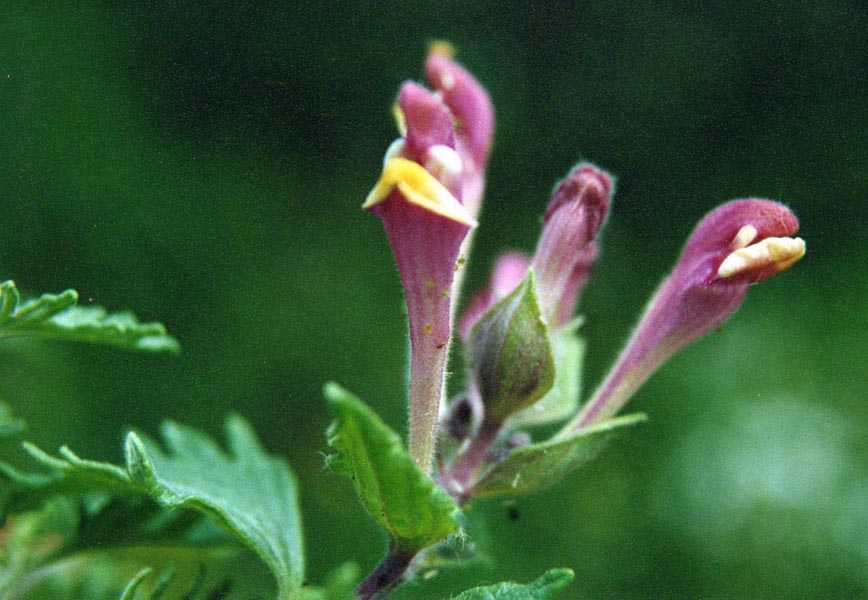
A perennial of the Lamiaceae family, Scutellaria orientalis is distributed from southeastern Europe to Central Asia and the Middle East, present in Turkey, the Caucasus, Iran, and adjacent regions. It occupies calcareous rockeries, screes, dry stony slopes, and old walls, generally in warm and sunny exposure.
It forms low and spreading clumps, semi-woody at the base, 10 to 15 cm in height, with a subsarmentose character, gradually spreading between the stones. The leaves are small, cut to deeply crenate, medium green to grayish, slightly pubescent, giving them a very recognizable matte and finely textured appearance.
The color combination of the flowers is quite unique in the genus: the bilabiate corollas combine an upper lip of a fairly strong pink-carmine to purple and a lower lip of cream-yellow to pale yellow, the whole emerging from bracts colored in similar shades. This warm and contrasting bicolor, unusual among skullcaps, is the most striking feature of the species.
In its natural habitat, its flowering extends from June to August. In cultivation, it generally blooms from June to July.
It requires perfect drainage, a substrate that is poor to moderately fertile, preferably calcareous, and full sun exposure. It tolerates summer drought well once established. An excellent plant for dry rockeries, walls, and gravel gardens with a Mediterranean or steppe character.