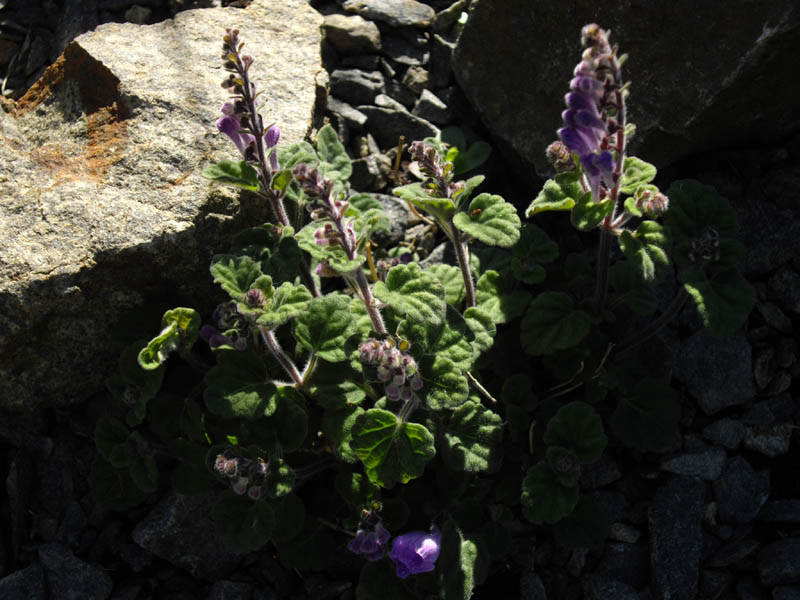
Perennial of the Lamiaceae family, this variety is native to East Asia, found in Japan, Korea, and China, where it grows in rock gardens, sunny rocky slopes, rocky edges, and well-drained embankments, at low and medium altitudes.
It forms low and dense clumps 10 to 20 cm in height, with a semi-spreading habit, with erect stems at the time of flowering. The foliage is one of its most immediately recognizable features: the leaves are small, rounded to oval, crenate, dark green, densely covered with short hairs on both sides, and distinctly wrinkled, with the blade bulging between the veins very markedly. This texture, both velvety and sculpted, is visible to the naked eye and gives the foliage an unusual relief in the genus. The flowering stems are distinctly tinged with brown-purple.
The bilabiate flowers are gathered in upright and well-stocked terminal spikes, of a fairly deep violet-blue to lilac; the lower lip has well-visible white speckles on a violet background. The flowering is abundant and generously covers the foliage.
In its natural habitat, its flowering extends from May to July. In cultivation under our climates, it generally blooms from May to June, sometimes with a slight resurgence.
It is cultivated in full light, in well-drained, light, moderately fertile soil, and tolerates rocky substrates. It is perfectly suited to sunny rock gardens and walls, where its winter persistent foliage remains decorative. Its hardiness is generally satisfactory under cold winters, provided the drainage is impeccable.