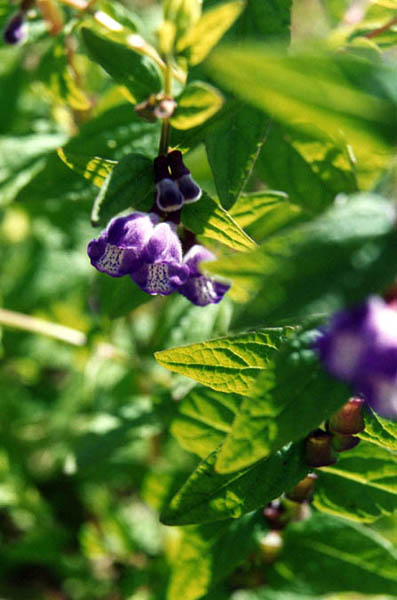
Perennial of the Lamiaceae family, Scutellaria galericulata is a native species widely spread in Europe, temperate Asia, and North America. It frequents riverbanks and streams, reed beds, wet meadows, and ditches, always in cool to moist environments, in plains as well as in mid-mountain areas.
It forms bushy clumps 20 to 50 cm in height, with erect or slightly spreading quadrangular stems, characteristic of the Lamiaceae. The leaves are oval to lanceolate, crenate-toothed, of a fairly bright medium green, slightly wrinkled, arranged in opposite pairs along the reddish stems; their texture vaguely resembles that of some mints.
The bilabiate flowers, inserted in the axil of the upper leaves and all oriented to the same side, are of a fairly intense blue-violet with a whitish spotted throat. Solitary at each node, they succeed from bottom to top along the stems, giving a discreet but continuous effect. This mode of axillary insertion, flower by flower, immediately distinguishes this species from Scutellaria with dense terminal spikes like S. alpina or S. baicalensis.
In its natural habitat, its flowering extends from June to September.
It is cultivated in cool to moist soil, rich in humus, in sun or partial shade, and is suitable for riverbank gardens and naturalistic compositions in moist environments. It is little used in classic rock gardens but deserves a place in gardens with a wild character.