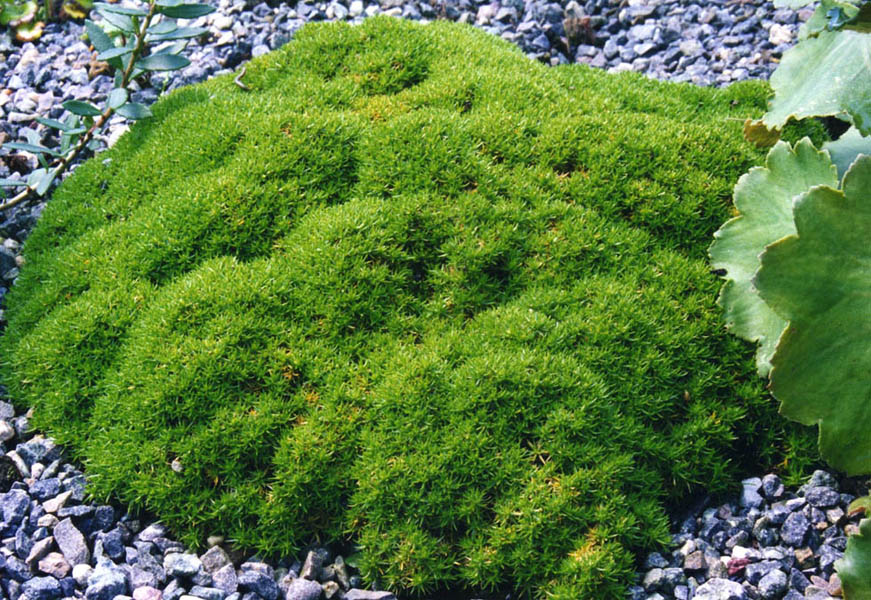
Perennial of the Caryophyllaceae family, Scleranthus uniflorus is native to New Zealand, where it grows in alpine lawns, rocky outcrops, and scree of the mountainous areas of the two main islands. It is a plant of open, well-drained environments, subject to severe climatic conditions.
It forms dense, tight, and perfectly domed cushions, with a uniform bright green, reaching 30 to 50 cm in diameter for only 5 to 8 cm in height. The surface of the cushion has a finely divided, almost mossy texture, composed of very branched stems bearing tiny closely packed subulate leaves. The habit is remarkably regular and geometric, which is one of the most striking features of the species.
The flowers are tiny, greenish, without petals, and practically invisible to the naked eye; the plant's interest lies entirely in the architectural quality of its cushions.
In its natural habitat, its flowering extends from spring to the austral summer.
In cultivation, it requires a very well-drained, poor soil, in full light, with good ventilation. It tolerates cold but fears stagnant winter moisture, which can cause rot at the heart of the cushion. It is advantageously cultivated in rock gardens or alpine troughs, where its sculpted form produces a striking effect amidst gravel and stones.