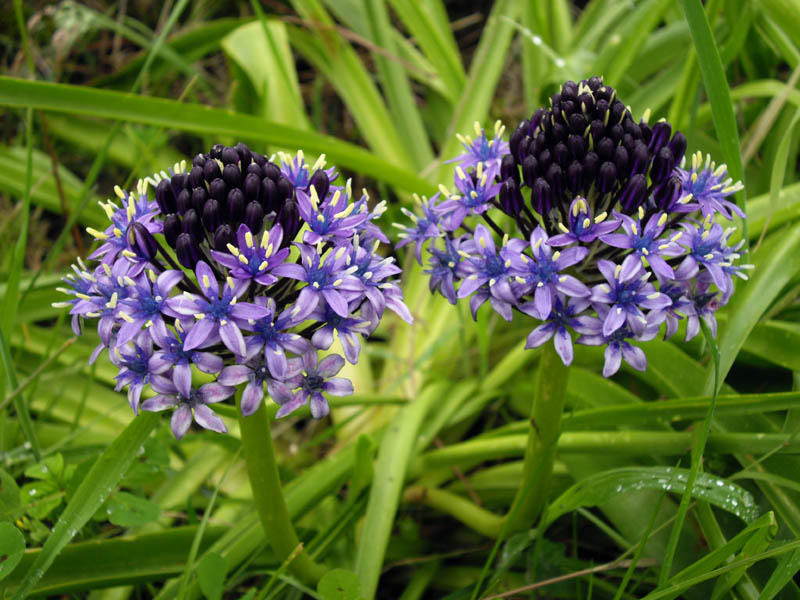
A perennial bulbous plant from the Asparagaceae family, Scilla peruviana is native to the western Mediterranean basin, mainly from the Iberian Peninsula, Morocco, Algeria, and Italy, despite its misleading epithet which does not refer to Peru. Its name is believed to be due to an old confusion related to the name of a ship, the Peru, which supposedly transported the first bulbs to England in the 17th century.
It frequents wet meadows, fresh garrigues, and coastal lawns, from sea level to moderate altitudes. It forms a large rosette of ribbon-like leaves, long and bright green, semi-evergreen, from which one or more robust stems rise, 20 to 40 cm tall.
The inflorescence is a dense and conical cluster, spectacular, capable of gathering fifty flowers or more. The blooming opens from the periphery to the center, revealing a striking contrast between the blue-lilac flowers with cream stamens and the central dome of tightly packed buds, dark violet to almost black.
In its natural habitat, its flowering extends from April to June.
In cultivation, it requires well-drained soil, a sunny exposure, and winter protection in cold climates. It tolerates light frosts but dreads prolonged cold and wet winters.