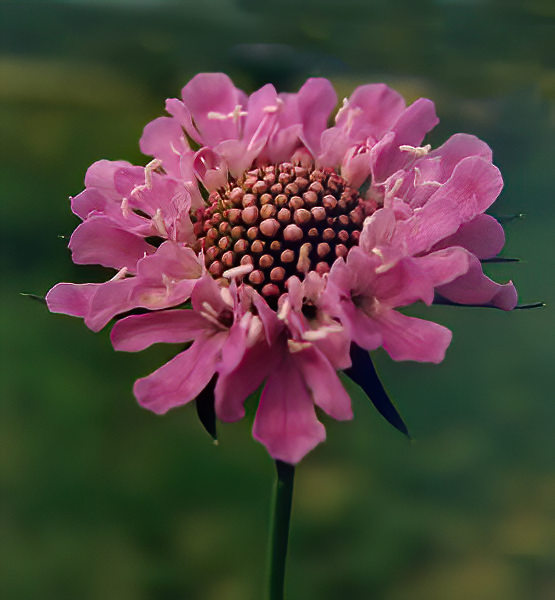
Scabiosa columbaria, horticultural form or variety with pink flowers.
Perennial of the Caprifoliaceae family (formerly Dipsacaceae), the small scabious is widely spread in Europe, from the British Isles to Central Asia, frequenting dry calcareous grasslands, embankments, and sunny rocky areas, from the plains up to about 2,000 meters in the alpine massifs.
It forms a loose clump with slender, branched stems, reaching 30 to 50 cm in bloom. The basal leaves are oval to slightly lobed, the cauline leaves more finely pinnatisect.
The plant represented here shows flower heads of a deep pink to rose-magenta, noticeably more vivid than the usual lavender to pale lilac hue of the wild populations of the species. This color could correspond to a horticultural selection, as several pink-flowered cultivars are known in commerce, although the precise identification of this form is not established with certainty.
In its natural habitat, the species blooms from July to September. In cultivation, it can start as early as June.
It thrives in well-drained soil, preferably calcareous, poor to moderately fertile, in full sun, and dreads stagnant moisture in winter. It readily attracts butterflies and bees.